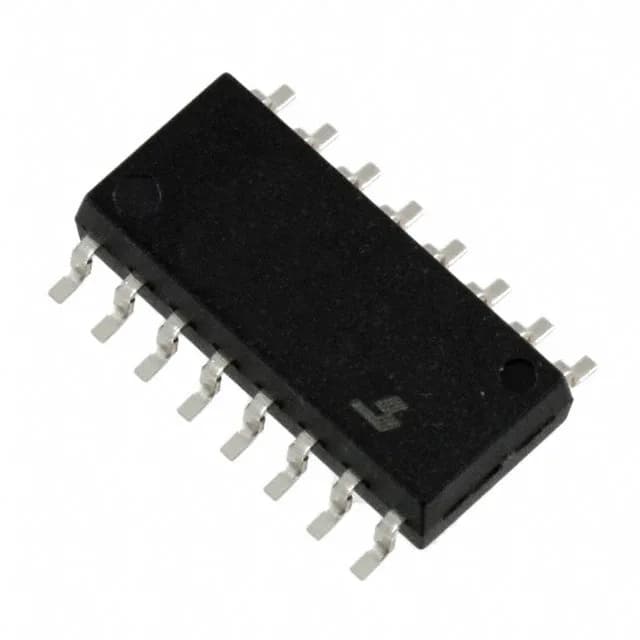
Four isolated channels in a single SO-16
The Toshiba TLP292-4(V4LATPE packs four independent phototransistor optocoupler channels into a 16-SOIC package, each rated for 3750Vrms of galvanic isolation. That channel density saves board area compared to populating four single-channel parts, and the 16-SO (0.179", 4.55mm width) footprint is a standard surface-mount layout that fits most pick-and-place flows without a special nozzle. Input side accepts both AC and DC signals, so you can directly couple a 50/60 Hz mains-sense line or a DC logic level without adding a bridge rectifier or polarity diode.
3750Vrms isolation — what it buys the BOM
The 3750Vrms isolation rating covers basic safety isolation for industrial equipment, motor drives, and power supplies where the primary-to-secondary withstand voltage needs to hold off transient surges. It is not a reinforced isolation rating (typically 5000Vrms or higher), but it is adequate for many 240VAC line-isolated interfaces and meets the creepage requirements of a 16-SO package when the PCB layout respects the clearance rules. Operating temperature spans -55°C to 125°C, which puts this part in the military/industrial grade tier. The 125°C upper limit also gives headroom for self-heating when driving the output near the 50mA per-channel ceiling.
CTR margins and switching speed
Current transfer ratio spans 50% minimum to 600% maximum at a forward current of 500µA. That wide range means the part can reliably turn on a downstream logic input even with a weak LED drive, but the CTR tolerance must be budgeted in the pull-up resistor calculation — a 50% CTR at the low end may require a lower resistor value to guarantee a logic high across temperature. Typical rise and fall times are 2µs and 3µs, with turn-on and turn-off times both 3µs, so the part is comfortable for 10-100 kbps data rates but not for high-speed isolation (look at a digital isolator for Mbps links). Vce saturation is clamped at 300mV maximum, which keeps the output voltage drop low when the transistor is fully on — important for maintaining noise margin on a 3.3V rail. The forward voltage is a typical 1.25V, so the input LED can be driven directly from a 3.3V or 5V logic output with a series resistor sized for the 50mA absolute-maximum forward current.