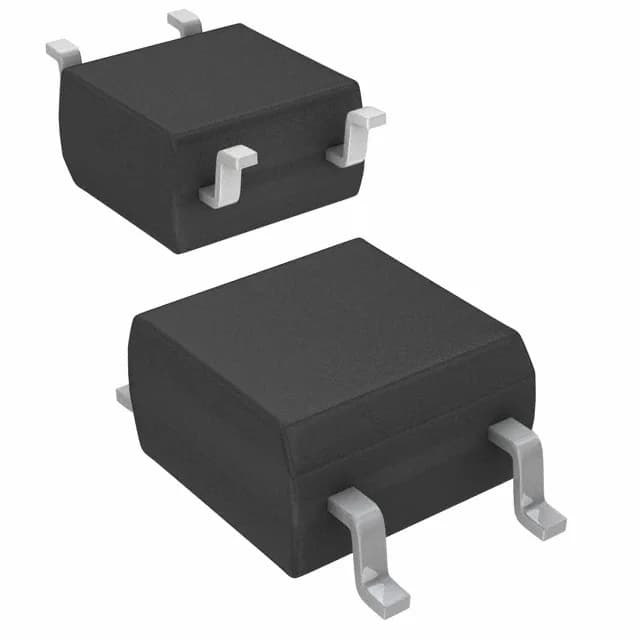
Triac coupler for isolated AC switching
The Toshiba TLP268J(TPR,E is a single-channel triac output photocoupler in a 6-SOP surface-mount package. It combines a GaAs infrared LED on the input side with a photo-triac output that includes a zero-crossing detection circuit. The part is rated for 600 V off-state voltage and 3750 Vrms isolation, making it suited for switching 100–240 VAC loads in industrial controls, solid-state relays, and motor starters where galvanic isolation between the logic and power domain is required.
The zero-crossing circuit ensures the triac only turns on when the AC mains voltage crosses zero, which minimizes inrush current and reduces EMI generated by the switching event. This is the feature to look for when driving inductive loads like solenoids, contactors, or small motors — it avoids the current spike that would occur if the triac fired mid-cycle. The turn-on time is 100 µs, fast enough to synchronise with the zero-crossing window at 50/60 Hz line frequencies. If your application requires phase-angle control (dimming, soft-start), you need the non-zero-crossing variant TLP267J(TPL,E instead.
Trigger current and hold current — sizing the drive and load
The typical hold current (Ih) is 200 µA. This is the minimum load current that keeps the triac latched once triggered. For very light loads (e.g., a 5 W LED lamp on 230 VAC, drawing ~22 mA), the hold current is easily satisfied. But if the load is a high-impedance relay coil or a small fan that draws under 200 µA, the triac may drop out at the next zero crossing. In that case, add a dummy load resistor across the output to raise the current above Ih.
Isolation and safety approvals
With 3750 Vrms isolation and approvals from CQC, cUR, and UR, this coupler meets the basic insulation requirements for reinforced isolation in mains-connected equipment. The off-state voltage of 600 V gives derating margin for 240 VAC lines (peak ~340 V) and covers 277 VAC lighting circuits. The 6-SOP package has a 4.40 mm body width and 0.173" lead pitch — a compact footprint for high-density PCB layouts.