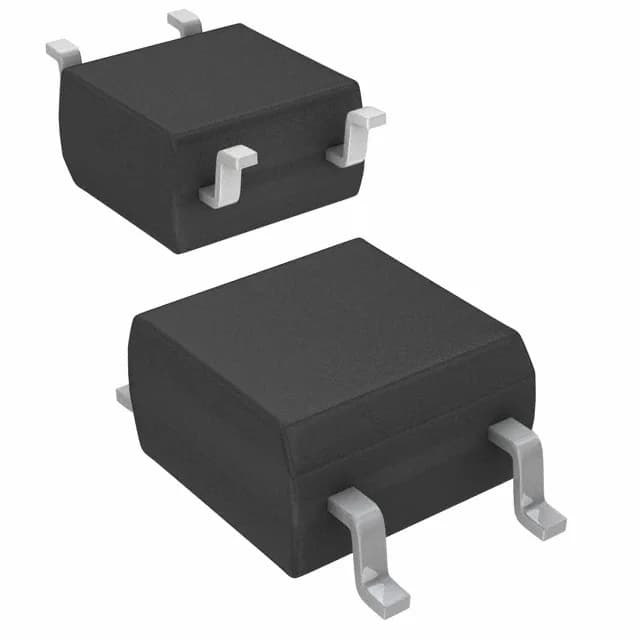
Triac output coupler for AC load control
The Toshiba TLP266J(V4T7TL,E is a single-channel triac output optocoupler with an integrated zero-crossing circuit, designed to drive low-current AC loads such as solid-state relays, solenoid valves, and small motors from a logic-level control side. The output is a Triac rated for 600 V off-state voltage and a maximum on-state RMS current of 70 mA, making it suitable for 120 VAC and 240 VAC line-voltage switching in industrial and appliance control boards. The zero-crossing feature minimizes inrush current and conducted EMI when the load is switched on near the AC line zero voltage.
3750 Vrms isolation and transient immunity
With 3750 Vrms isolation between input and output, this coupler provides reinforced insulation for safety-rated designs where the control side must be galvanically separated from the mains-powered load. The minimum static dV/dt of 200 V/µs on the output ensures the triac does not falsely trigger on fast voltage transients from inductive load switching or line noise — a common failure point in noisy industrial environments.
Trigger current and drive requirements
The LED trigger current (Ift) is 10 mA maximum, with a typical forward voltage of 1.27 V. This means a standard 5 V or 3.3 V logic output can drive the input side through a current-limiting resistor without needing a separate driver transistor. The 30 µs turn-on time is fast enough for line-frequency (50/60 Hz) switching but not intended for high-speed PWM or phase-angle control. Once triggered, the triac latches on until the load current drops below the 600 µA typical hold current, which occurs naturally at the AC zero crossing.
Package and temperature range
Housed in a 6-pin SOP (6-SOP) package with 4.40 mm body width, the device is surface-mount and suited for automated assembly.