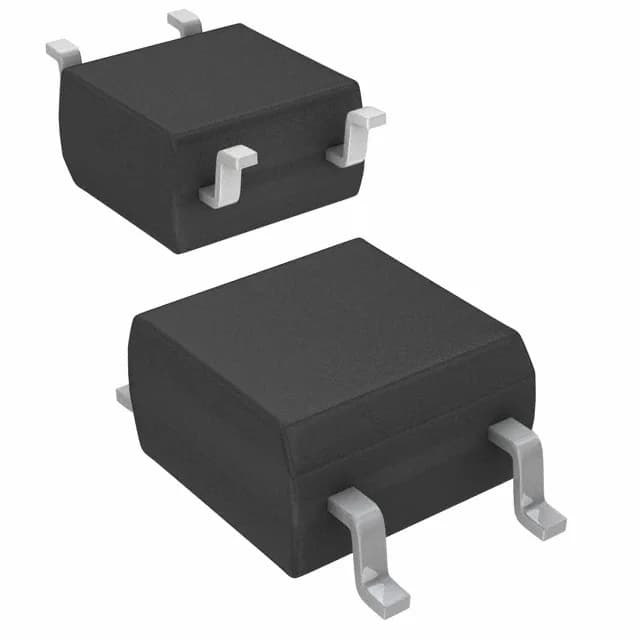
The Toshiba TLP266J(T7-TPL,E is a single-channel triac-output optocoupler in a 6-SOIC 4-lead surface-mount package. It provides 3750Vrms isolation between the LED input and the triac output, with a 600 V off-state voltage rating that suits 240 VAC line switching in industrial controls, solid-state relays, and motor-drive interface circuits. The built-in zero-crossing circuit turns on the triac near the AC voltage zero crossing, which cuts inrush current and radiated EMI when driving resistive or lightly inductive loads like heaters, solenoids, and contactor coils.
The 3750Vrms isolation voltage meets basic reinforced insulation requirements for mains-connected equipment per UL and cUL. For a 240 VAC line, the 600 V off-state voltage gives a healthy margin — the triac blocks the full peak of 340 V plus transients without breakdown. The 200 V/µs minimum static dV/dt prevents the triac from false-triggering on fast voltage spikes from nearby relays or switching power supplies, which is a common failure point in noisy industrial panels. If your design drives a load that generates high dV/dt (like a motor start or capacitor bank), this part's dV/dt rating is a deliberate choice over lower-rated alternatives.
Package and rework — the 6-SOIC 4-lead reality
The 6-SOIC 4-lead package is a compact surface-mount body with only four pins — two on the input side (LED anode and cathode) and two on the output side (triac MT1 and MT2). The 4.40 mm body width and 0.173" pitch are standard SOIC dimensions, so the footprint matches common 6-pin SOIC optocouplers. Under a hot-air station, the small thermal mass means it reflows quickly at 260°C peak (typical lead-free profile). The 6-SOP supplier device package is the same mechanical outline; the naming just follows Toshiba's internal code. No exposed pad to worry about, so hand rework is straightforward.
Lifecycle and compliance
It is part of Toshiba's TLP series, a long-running optocoupler family with broad distribution support. The cUL and UL approvals are already in place, which simplifies safety certification for end equipment sold in North American markets.