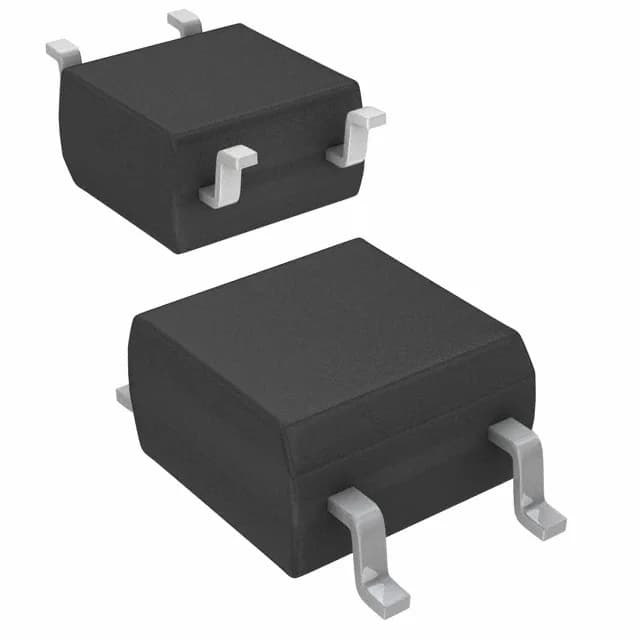
Triac coupler for AC load control — 600 V off-state, 70 mA on-state
The Toshiba TLP265J(V4-TPR,E is a single-channel triac output optocoupler in a compact 6-SOIC surface-mount package with 4 leads. It provides galvanic isolation rated at 3750Vrms between the LED input and the triac output, making it suitable for driving low-current AC loads such as solenoids, relays, or small motors from a microcontroller I/O pin. The output is a non-zero-crossing triac (no zero-crossing circuit), which means the triac can be triggered at any phase of the AC cycle — useful for phase-angle control or applications where the turn-on point must be adjustable.
Key ratings that drive the BOM decision
Off-state voltage is rated at 600 V, and the on-state RMS current is 70 mA maximum — enough to switch small AC loads directly without an external triac, but keep the load budget under that ceiling. The static dV/dt is a minimum of 500 V/µs (typical), which means the triac resists false turn-on from fast voltage transients on the AC line; this matters in motor-drive or relay-coil environments where commutation spikes are common. Turn-on time is 20 µs, fast enough for line-frequency switching at 50/60 Hz.
Lifecycle and compliance — active, RoHS compliant
It is RoHS compliant. The approval agencies listed include CQC (China), cUR and UR (UL recognized for US/Canada), and VDE (Germany), which covers most global equipment certification requirements.
Because the zero-crossing circuit is absent (listed as 'No'), the triac turns on immediately when the LED current exceeds the 10 mA Ift threshold, regardless of the AC line voltage phase. This allows phase-angle control (dimming, soft-start) but also means the load sees a step voltage at turn-on, which generates higher inrush current and EMI. If your application requires zero-crossing switching to reduce inrush and EMI, look at the TLP265J(TPL,E variant which may differ — verify its ordering code. For simple on/off switching of resistive loads like heaters or incandescent lamps, the non-zero-crossing version is fine.