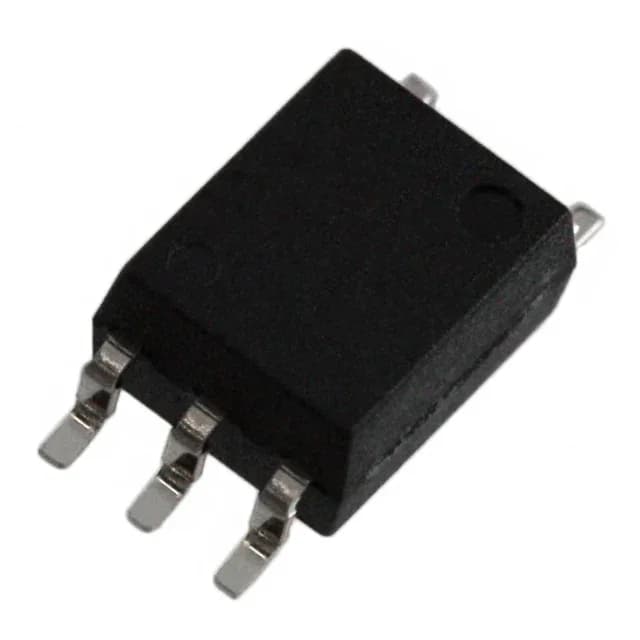
What this photocoupler solves: AC-coupled isolation without extra rectification
The Toshiba TLP2391(E is a single-channel photocoupler that accepts both AC and DC input signals, which means it can directly couple a mains-frequency or bipolar signal across the isolation barrier without an external diode bridge or level shifter. That AC/DC input capability is the feature that sets it apart from most 10MBd optocouplers, which only handle DC inputs. The push-pull, totem-pole output drives logic inputs directly — no pull-up resistor needed — and the 3750Vrms isolation rating covers reinforced insulation requirements for industrial motor drives, PLC I/O modules, and medical power supplies. The 10MBd data rate is fast enough for most fieldbus interfaces (RS-485, CAN) and general-purpose isolated serial links, though it trails the 15MBd of the TLP2361 family.
10MBd data rate — is it enough for your bus?
At 10MBd, the TLP2391(E handles 10 Mbps serial data with a 100 ns max propagation delay and 3 ns rise/fall times. That is sufficient for isolated SPI at 10 MHz, RS-485 at 10 Mbps, and CAN at 1 Mbps with margin. If your design runs a faster serial protocol (e.g., 20 Mbps LVDS or 15 Mbps Profibus), the TLP2361(V4,E offers 15MBd with 80 ns propagation delay — but it only accepts DC input, so you lose the AC-coupling advantage.
Common-mode transient immunity: 20 kV/µs keeps data clean in noisy environments
The 20 kV/µs minimum common-mode transient immunity means the output does not glitch when a high-voltage transient jumps across the isolation barrier. This matters in motor drives where the inverter switching node swings several hundred volts in nanoseconds — a photocoupler with lower CMTI would toggle falsely, corrupting the feedback loop. The TLP2391(E's 20 kV/µs is on par with the TLP2361 family and sufficient for most industrial inverter and servo drive designs.