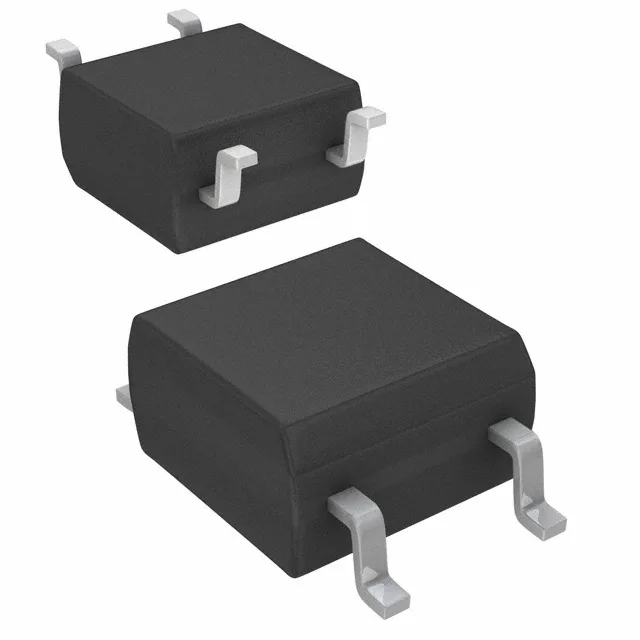
3750Vrms isolation, AC/DC input — what this photocoupler is for
The Toshiba TLP184(V4-TPR,SE is a single-channel photocoupler with an AC/DC input LED and a phototransistor output, packaged in a 6-pin SOP (6-SOP) for surface-mount assembly. Its 3750Vrms isolation rating suits it for galvanic isolation in industrial controls, power-supply feedback loops, and PLC I/O modules where you need to pass a DC or AC signal across a safety barrier. The AC/DC input means the LED lights regardless of polarity, so you can use it with bipolar AC signals or simply not worry about orientation on a DC line — a practical convenience for board-level repair and rework where the input wiring might be reversed.
The current transfer ratio (CTR) is specified as a minimum of 50% and a maximum of 600%, both at a forward current of 5mA. That is a wide bin — a 12:1 spread — which means the output transistor's collector current for a given input current can vary significantly from unit to unit. For a design engineer, this drives the worst-case load resistor calculation: you size the pull-up or base drive assuming the minimum CTR to guarantee the output saturates, and you check that the maximum CTR does not overdrive the next stage. For the procurement side, the wide CTR bin means the part is a single stocking line that covers multiple gain groups — you do not need to order separate CTR-rank suffixes, which simplifies inventory. The 50mA absolute maximum output current per channel sets the hard ceiling on the load the transistor can sink.
The output transistor is rated for 80V collector-emitter and 50mA continuous current, so it can directly switch 24V or 48V industrial logic rails, relay coils, or small solenoids with an external base resistor. The typical turn-on and turn-off times are 3µs each, with rise and fall times of 2µs and 3µs respectively. That puts the practical switching frequency in the tens of kilohertz — fine for 50/60 Hz mains zero-crossing detection, slow PLC inputs, or power-supply feedback at 100 kHz or below. It is not a part for high-speed digital isolation at MHz rates; for that you would look at a digital isolator or a faster optocoupler family.
The 110°C ceiling is fine for most factory-floor PLCs, motor-drive control boards, and outdoor telecom equipment that sees ambient heat but not direct engine contact. The 3750Vrms isolation is a 1-minute withstand rating per the standard — enough for reinforced insulation in 250Vrms mains circuits, but check your specific safety standard (IEC 60950, IEC 62368) for the required creepage and clearance distances, which depend on the PCB layout, not just the device rating.
For volume production commitments, an RFQ is the right next step to lock in allocation and price breaks.