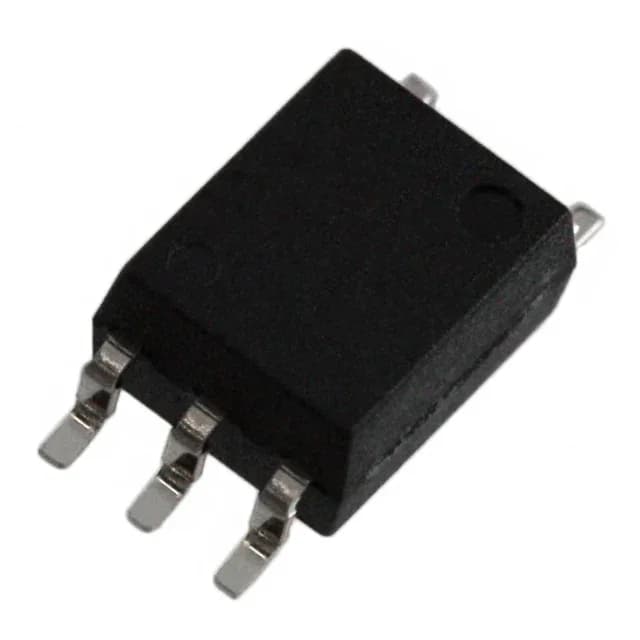
Gate-drive optocoupler for IGBTs and power MOSFETs
The Toshiba TLP151A(TPR,E) is a single-channel optical coupling gate driver in a 6-SOIC-5 surface-mount package. It delivers 600mA peak output current with 3750Vrms isolation, making it a fit for driving IGBTs and power MOSFETs in motor drives, inverters, and industrial power supplies. The 50ns typical rise and fall times support switching frequencies where dead-time margins are tight, and the 20kV/µs common-mode transient immunity keeps the output state clean under fast dv/dt from the power stage. The output supply range of 10V to 30V covers standard gate-drive voltages for medium-voltage IGBT modules and logic-level MOSFETs.
Peak current and switching speed — what drives the BOM decision
The 600mA peak output dictates which gate charge can be switched within the 50ns rise/fall window. For a typical IGBT with 100 nC gate charge, this driver can charge the gate in roughly 170 ns — enough for 50-100 kHz switching in a motor drive. The 400mA high/low source-sink capability is the continuous rating; the peak figure handles the initial gate-charge surge. If your design needs to drive a larger module (e.g., 300 nC gate charge), the TLP352(TP1,F) with 2.5A peak output is the next tier up in the same 6-SOIC footprint. Propagation delay is 500ns max with 350ns pulse-width distortion. That 350ns skew between turn-on and turn-off sets a lower bound on the dead-time you must program in the controller — budget at least 400ns dead-time to avoid shoot-through. The 50ns rise/fall symmetry helps keep the dead-time budget balanced across temperature.
Isolation and transient immunity for noisy environments
Rated at 3750Vrms isolation with cUL and UL approval, the TLP151A meets basic isolation requirements for motor-drive and power-supply applications where reinforced isolation is not mandated. The 20kV/µs common-mode transient immunity is the key spec for inverter legs: when the high-side IGBT switches, the floating ground can slew at several kV/µs, and a driver with lower CMTI would glitch the gate signal. This part holds its output state through that transient, avoiding false turn-on.
Lifecycle and sourcing posture
No immediate allocation risk flagged, but the gate-driver market has seen lead-time stretches in past cycles — worth locking in a forecast if volume ramps.