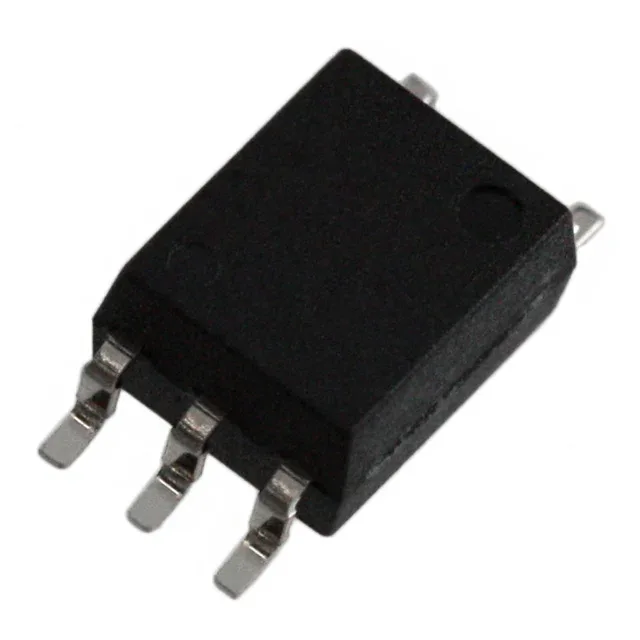
The Toshiba TLP104(TPR,E) is a single-channel photoelectric coupler with a DC input and an open collector output, rated for 1 Mbps data rate and 3750 Vrms isolation. It comes in a 6-SOIC package with 5 leads, surface-mount, and operates from 4.5 V to 30 V on the output side.
The 1 Mbps data rate covers most industrial fieldbus speeds (Profibus DP at 12 Mbps is faster, but Modbus RTU at 115.2 kbps, CAN at 1 Mbps, and many PLC backplane buses are within range). The open collector output lets you pull up to any voltage within the 4.5 V to 30 V supply range, so the same part can drive a 5 V CMOS logic input or a 24 V PLC input card without a level shifter. The 8 mA per-channel output current is enough to drive a typical optocoupler load resistor (e.g., 4.7 kΩ at 24 V pulls about 5 mA), but check the LED forward current budget — the input side needs 1.61 V typical forward drop and up to 25 mA DC forward current.
3750 Vrms isolation and 15 kV/µs CMTI
The 3750 Vrms isolation rating meets basic insulation requirements for 300 Vrms working voltage per IEC 60950-1, suitable for motor drives, power supplies, and industrial controls where the control side must be galvanically isolated from the power stage. If the CMTI is too low, the output glitches; 15 kV/µs covers most IGBT gate-drive applications up to about 1200 V bus voltage with reasonable layout.
Propagation delay budget
Maximum propagation delay is 550 ns for tpHL (high-to-low) and 400 ns for tpLH (low-to-high). The asymmetry means the low-going edge is the slower one — account for that in timing closure if the optocoupler is in a feedback loop or a synchronous data path. For a 1 Mbps signal with a 1 µs bit period, 550 ns eats over half the bit time, so this part is best for asynchronous signals (fault flags, enable lines, status indicators) rather than a clocked data stream.