680 nA quiescent current — the battery-life spec
The Toshiba TCR3UG19A,LF is a single-output positive fixed LDO regulator in the TCR3UG series, delivering a regulated 1.9V at up to 300 mA. Its standout feature for portable and always-on designs is the 680 nA quiescent current — that is the current the regulator itself burns just to stay alive, independent of the load. The 70 dB PSRR at 1 kHz means it also cleans up switching-noise ripple on the input rail well enough to feed an analog front-end or RF section without an extra post-filter.
Dropout headroom and input voltage
Maximum dropout is 0.457 V at the full 300 mA load. That means with a 1.9 V output, the input needs to stay above about 2.36 V worst-case to maintain regulation — a 3.0 V or 3.3 V rail has comfortable margin. The maximum input voltage is 5.5 V, so it can run directly from a single-cell Li-ion (4.2 V full charge) or a 5 V USB rail without a pre-regulator.
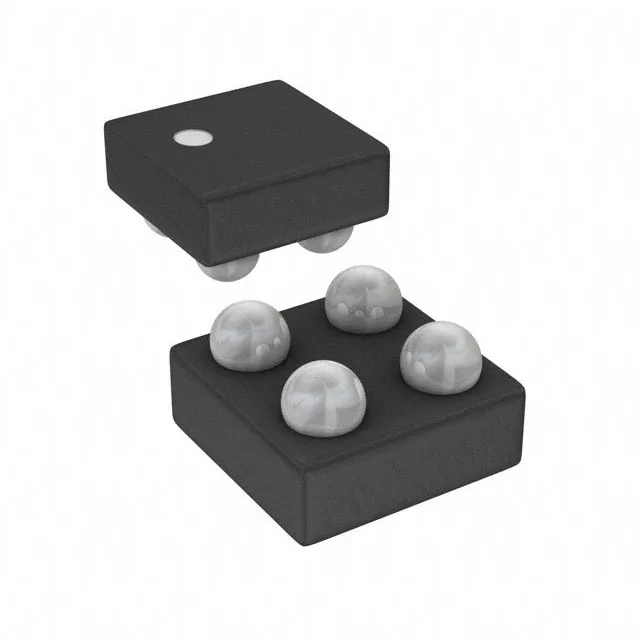
The part comes in a 4-bump WLCSP (Wafer-Level Chip-Scale Package) with a 0.65 x 0.65 mm footprint — the 4-WCSPF. That is a tiny land pattern, roughly the size of a grain of sand. It saves board area in a compact design like a wireless earbud, medical patch, or IoT module, but it also means the PCB assembly house needs experience with fine-pitch WLCSP: the bumps are the package, so solder-paste volume and placement accuracy matter. The Enable control feature lets a GPIO or power-management IC shut the regulator down completely, pulling near-zero current in the off state. Protection includes over-current and over-temperature shutdown, so it handles a momentary short on the output without damage.