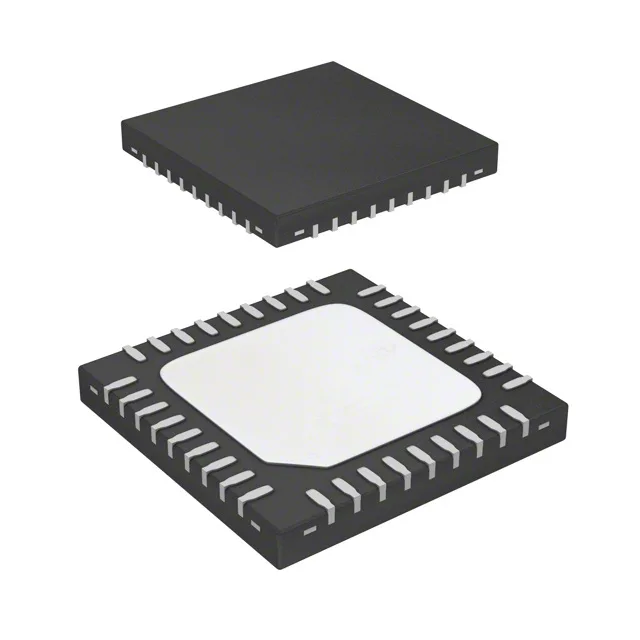
Motor driver for appliance and industrial motion
The Toshiba TB62262FTAG,EL is a fully integrated motor driver combining control logic and power MOSFETs in a single 36-WQFN package. It drives one bipolar stepper motor (full, half, or quarter step) or two brushed DC motors using the four half-bridge outputs. The PWM interface accepts standard timer signals from an MCU, and the load voltage range of 10 V to 35 V suits 12 V and 24 V appliance motors, pumps, fans, and actuator stages.
Load voltage and output current — sizing the motor rail
The load supply (VM) accepts 10 V to 35 V, which covers common 12 V and 24 V industrial and appliance bus voltages. The 800 mA continuous output per channel sets the motor torque ceiling; derate for ambient temperature and PCB copper area since the exposed pad must sink the heat. For a given motor winding resistance, Ohm's law gives the peak current — the 800 mA limit is per-bridge, so a bipolar stepper uses two bridges simultaneously.
Thermal environment — junction rating matters here
Operating junction temperature spans -20°C to 150°C. The 150°C absolute maximum is a silicon limit, not a continuous design target — motor-drive self-heating plus a warm enclosure can push junction well above ambient. The 36-WQFN exposed pad needs a solid thermal via array to the ground plane; without it, the part thermally limits well below 800 mA in a 70°C ambient. The -20°C low end means this part is not rated for freezer or outdoor cold-start environments; keep it in conditioned indoor or cabinet air.
Step resolution and motor type
The driver supports full-, half-, and quarter-step microstepping for bipolar steppers. Quarter-step reduces low-speed resonance and improves positional smoothness compared to full-step, but does not reach the finer microstep levels (1/8, 1/16) that higher-end drivers like the TB6600 offer. For brushed DC motors, the four half-bridges can be configured as two H-bridges, each driving one motor forward/reverse/brake. The part does not natively drive unipolar steppers — the four half-bridges are paired for bipolar windings, not centre-tap configurations.
For dual-sourcing resilience, the TC78H611FNG,EL is a functional peer with a similar half-bridge PWM architecture, though its load voltage range is lower (2.5 V typical) and its output current is higher (1.1 A); verify pin compatibility and thermal specs before substituting.