Average current mode PFC controller for offline supplies
The Texas Instruments UCC3817D is a power factor correction (PFC) controller operating in average current mode. It drives a boost-type preregulator to shape the input current waveform to follow the line voltage. Average current mode control provides stable operation across both continuous and discontinuous conduction modes, with a fixed switching frequency set by an external resistor and capacitor. The 220 kHz upper limit allows the use of smaller magnetic components than lower-frequency PFC controllers.
Supply bias and startup — sizing the auxiliary rail
The UCC3817D operates from a 12V to 17V supply rail, typical for an auxiliary winding on the PFC boost inductor or a downstream DC-DC converter. The 150 µA startup current is low enough to be supplied by a bleeder resistor from the bulk capacitor during initial power-up, with the IC taking over bias from the auxiliary winding once the output is established.
Switching frequency flexibility
The programmable switching frequency spans 6 kHz to 220 kHz. At the low end, the controller can synchronise to line frequency for valley-switching or low-EMI designs. At the high end, 220 kHz keeps the boost inductor physically small — a common choice for 300W to 1kW PFC stages in compact metal-enclosure supplies.
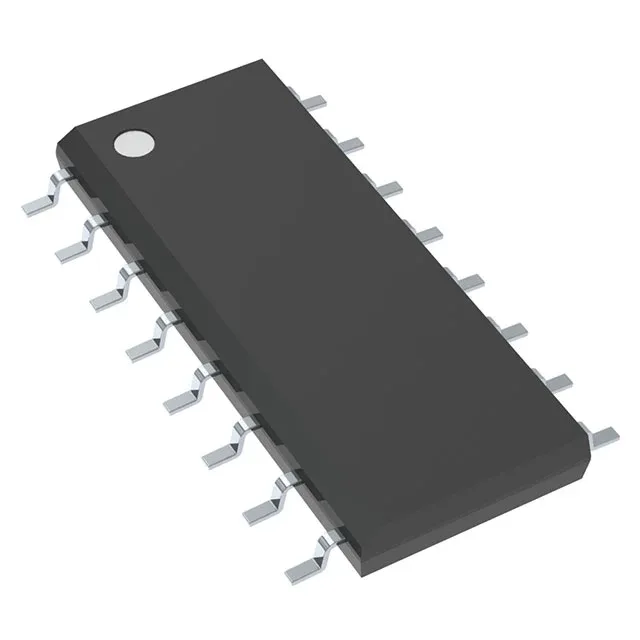
Housed in a 16-SOIC (3.90 mm width) surface-mount package, the UCC3817D suits automated assembly lines. The narrow SOIC body matches the standard footprint for PFC controllers in this power class; no special thermal management is needed for the controller itself, as the gate drive current is modest.