What this redriver does on the USB 3.0 trace
The Texas Instruments TUSB501DRFR is a single-channel USB 3.0 redriver that conditions the SuperSpeed differential pair to compensate for board trace losses. It accepts the 5 Gbps data stream from the host controller, applies input equalization and output de-emphasis, and re-drives a clean signal to the connector or downstream device. The 290 ps propagation delay is low enough that it does not eat into the USB 3.0 link timing budget. It operates from a 3 V to 3.6 V supply and draws 43.8 mA typical. The 1.25 pF input capacitance keeps the stub loading on the host side minimal.
Active, no LTB risk — but verify the date-code font
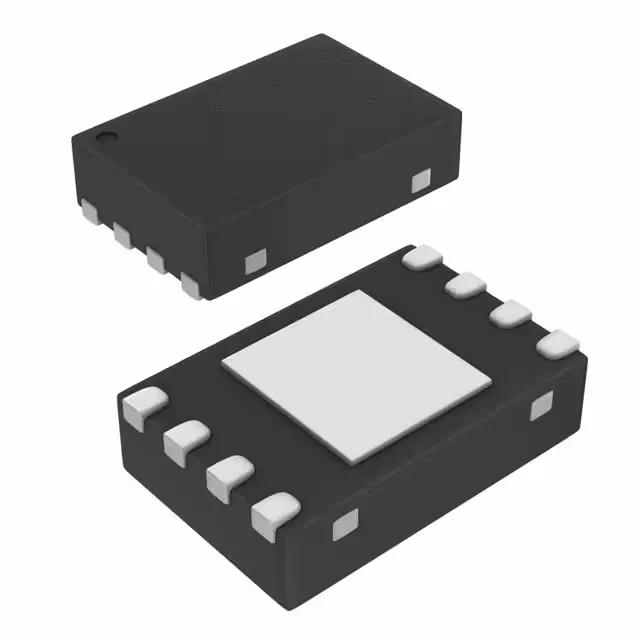
The TUSB501DRFR shows as Active in the current lifecycle stage. That said, this is a popular USB 3.0 Gen 1 redriver and has been in the channel long enough that gray-market reels with mismatched date-codes do turn up. If you are buying outside the authorized TI distribution chain, the laser etch on the 8-WSON package is a quick fingerprint: the font, spacing, and orientation should match TI's plant marking for the date-code week. Any sanding, re-mark, or inconsistent pad geometry on the exposed paddle is a red flag.
Package and layout — 8-WSON with exposed pad
The TUSB501DRFR comes in an 8-WFDFN exposed-pad package, also designated as 8-WSON (2 mm x 2 mm). Without that via stitch, the junction temperature climbs fast if the ambient is near the 85°C limit. The package is surface-mount only, no through-hole option. Decoupling should follow the typical recommendation: a 0.1 µF ceramic within 2 mm of the supply pin, plus a 1 µF bulk cap on the 3.3 V rail. The input and output differential pairs are AC-coupled; the redriver does not pass DC. The signal conditioning is configured via pin strapping — no I2C or SMBus interface, so the equalization and de-emphasis levels are fixed at power-up.
How it stacks against the TUSB1142RNQR
The closest functional sibling is the TUSB1142RNQR, a 10 Gbps redriver that handles USB 3.2 Gen 2. The TUSB501DRFR tops out at 5 Gbps (USB 3.0 Gen 1). The TUSB1142RNQR also has a different temperature grade — 0°C to 70°C commercial range — versus the TUSB501DRFR's -40°C to 85°C industrial range. If your design needs Gen 2 speed and stays in a controlled indoor environment, the TUSB1142RNQR is the speed upgrade. If you need the wider temperature range and Gen 1 is sufficient, the TUSB501DRFR is the correct fit.