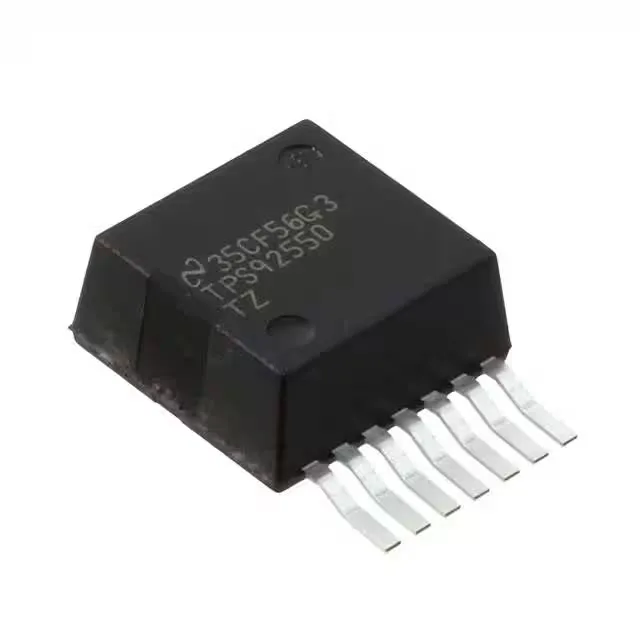
The Texas Instruments TPS92550TZ/NOPB is a constant-current step-down (buck) LED driver in a TO-PMOD-7 power module package. It integrates the switching FET, so the external BOM stays tight — just the inductor, input/output caps, and a few passives. The 400 kHz switching frequency is a practical middle ground: fast enough to keep the inductor small, slow enough that layout parasitics don't bite you on a two-layer board.
Dimming is handled by a PWM input, which means the LED current is chopped at the dimming frequency rather than linearly reduced. That keeps the color temperature stable across the dimming range — important for architectural and display lighting where the human eye catches a color shift. The PWM pin is logic-level compatible, so a microcontroller GPIO or a dedicated PWM controller can drive it directly.
The TO-PMOD-7 is a surface-mount power module with an exposed pad. Without that via stitch, the junction temperature climbs fast above 300 mA continuous in a 70°C ambient. The module integrates the inductor and switch, so the hot spots are contained, but the board still acts as the heatsink.
It is ROHS3 compliant.