What this regulator brings to the automotive rail
The TPS7B8433QDCYRQ1M3: 40 V input maximum covers load-dump and cold-crank transients. 0.23 V dropout at full load holds the 3.3 V rail through a sagging battery line. Quiescent current sits at 26 µA, low enough for always-on body controller modules and RTC keep-alive circuits where every microamp on the battery matters. The 55 dB PSRR at 1 kHz tells you it can clean up ripple from a switching pre-regulator or alternator whine, though for noise-sensitive analog front-ends you may want to check the full frequency curve against your load. Built-in protection includes over-current, over-temperature, and under-voltage lockout (UVLO), so a shorted load or a thermal event shuts it down gracefully rather than letting the smoke out. The enable pin lets a system supervisor gate the rail during sleep modes.
Dropout and headroom — the real-world margin
The 0.23 V dropout at 150 mA is the maximum over temperature, so in practice at 25 °C it will be lower. On a 12 V nominal automotive rail that dips to 5.5 V during cranking, you still have over 2 V of headroom — plenty. But if you are running this from a 3.6 V battery rail, that 0.23 V dropout eats into the regulation margin, and you need the input to stay above 3.53 V to keep the output at 3.3 V.
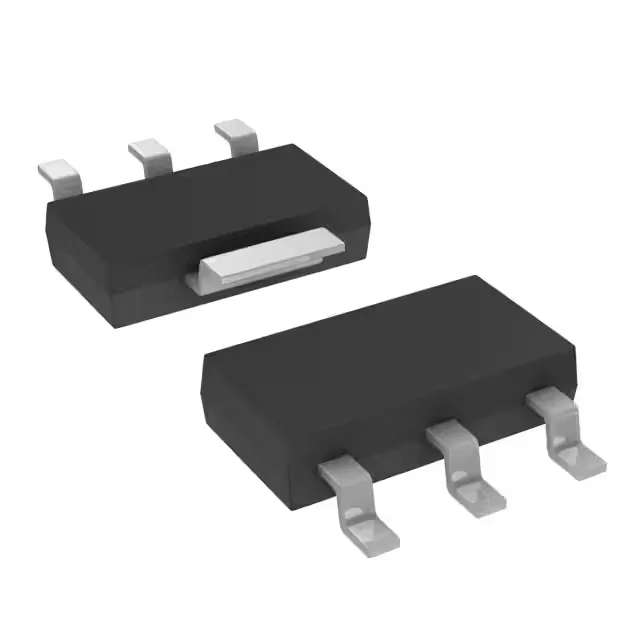
SOT-223-4 package (TO-261-4 equivalent) with a large tab for heat sinking. Surface-mount only; the tab is the output (VOUT) pin.
For a production BOM line, this part is a low-risk choice for new designs today.