40 V input LDO for automotive always-on and post-buck rails
The Texas Instruments TPS7A6601QDGNRQ1 is an adjustable-output, positive-voltage LDO regulator rated for 150 mA output current and a 40 V maximum input.
PSRR across frequency — what 60 dB to 40 dB means for a clean rail
The PSRR is specified at 60 dB at 100 Hz, dropping to 40 dB at 100 kHz. This profile is typical for an LDO with moderate loop gain; the 60 dB at low frequencies handles 100 Hz / 120 Hz ripple from a rectified input or a switching pre-regulator's fundamental, while the 40 dB at 100 kHz still provides meaningful attenuation of the first few harmonics of a 400 kHz to 2 MHz buck converter. For a 3.3 V analog supply rail fed from a 5 V switching regulator, this PSRR range is sufficient to keep ripple below 1 mVpp if the input ripple is under 100 mVpp. The dropout voltage is 0.45 V maximum at 150 mA, so a 5 V input holds a 3.3 V output with margin even through cold-crank dips to 4.5 V.
Protection suite and control features
The TPS7A6601QDGNRQ1 integrates over-current, over-temperature, short-circuit, and under-voltage lockout (UVLO) protection, plus a watchdog monitor on the enable pin. The Power Good output provides a sequenced-rail flag for an MCU or FPGA power-on reset. The Enable pin allows the rail to be gated by a system supervisor. For a safety-critical ECU rail, this protection set reduces external supervisory IC count.
Package, thermal, and mounting
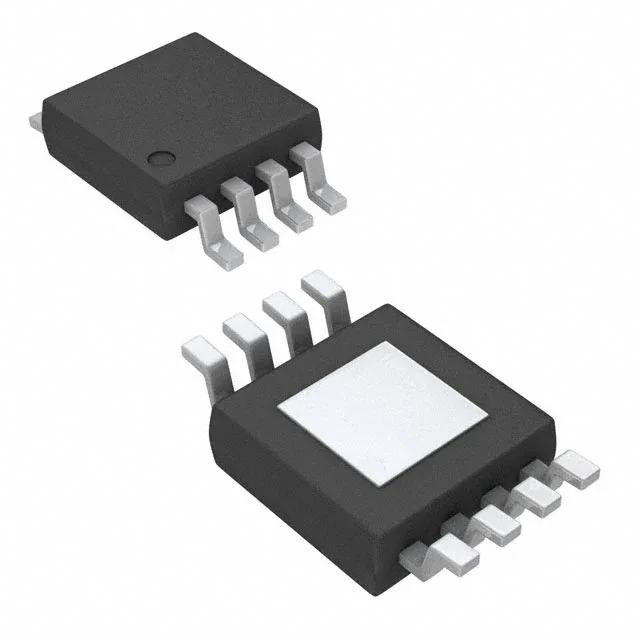
The 8-HVSSOP package (3.00 mm × 3.00 mm body) with an exposed thermal pad is the key to keeping junction temperature under the 150°C limit at full load in a 105°C ambient. The part is surface-mount only, and the tape-and-reel or cut-tape options suit both prototyping and production reels.
No NRND or last-time-buy notice is on the public record for this part. The AEC-Q100 qualification is documented; the part is listed under the automotive-grade category.