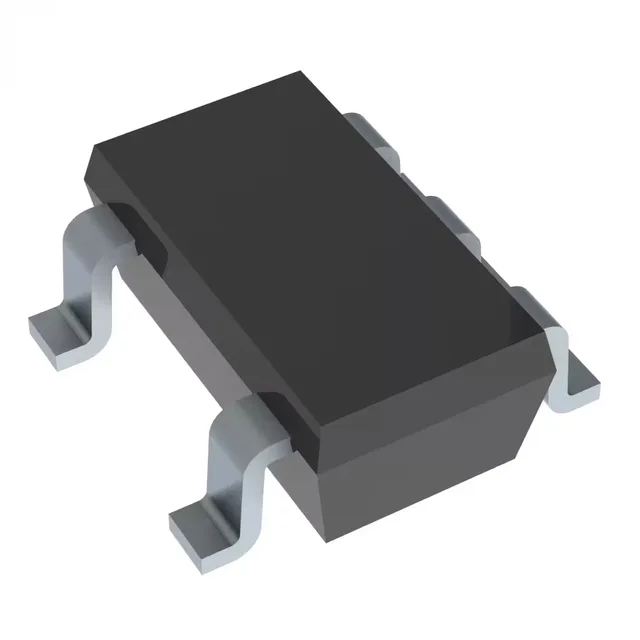
What this LDO brings to the board
The Texas Instruments TPS70912DBVT is a fixed-output 1.2V linear regulator rated for 150 mA continuous output. What sets it apart from a garden-variety LDO is the 30V maximum input — that is a wide input tolerance that lets it drop straight off a 24V industrial rail or an unregulated 12V battery line without a pre-regulator. It comes in a SOT-23-5 package, which is a standard footprint you will find on any rework station.
30V input, 1.2V out — the gap it fills
The PSRR profile — 80 dB at 10 Hz rolling off to 52 dB at 1 kHz — tells you it attenuates low-frequency ripple well but starts to let higher-frequency noise through. That is fine for powering a microcontroller or a low-speed ADC reference; for a high-resolution audio codec or a precision analog front-end running above 1 kHz, you would want a post-filter or a different LDO with higher bandwidth rejection.
Protection set — saves external parts
The TPS70912DBVT packs over-current, over-temperature, reverse-current, and under-voltage lockout protection into the SOT-23-5 package. The reverse-current block is the one that saves a diode on the output — if the output voltage ever exceeds the input (back-feed from a battery or a second supply), the regulator blocks reverse current flow. That is one less Schottky on the BOM. UVLO keeps the output off until the input rail is high enough for clean regulation, which avoids brownout glitches on power-up.
The SOT-23-5 package is a common footprint, so board layout is straightforward and the part is easy to hand-solder or reflow on a standard profile.