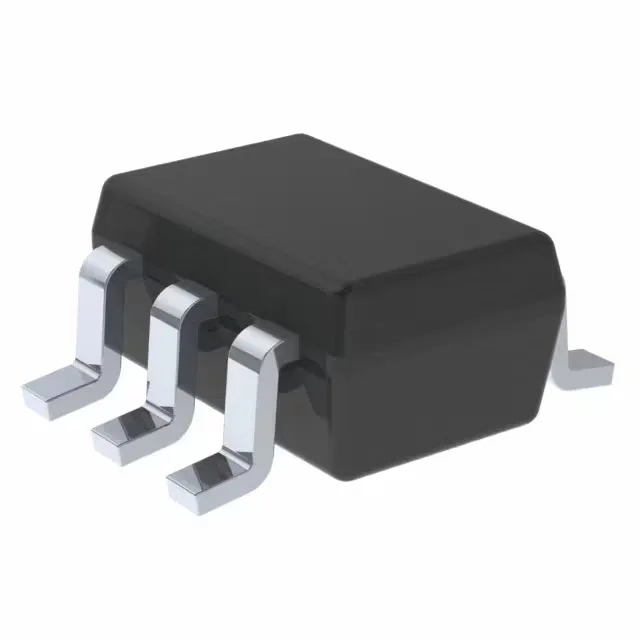
What this boost does on the board
The TPS61220DCKR is a step-up (boost) converter from Texas Instruments that takes a low input voltage as low as 0.7V and delivers a regulated adjustable output up to 6V. It integrates a 200mA switch and synchronous rectifier, so you get decent efficiency without an external Schottky diode. Typical use cases are single-cell alkaline, NiMH, or Li-ion battery-powered gear where you need a 1.8V to 5V rail for an MCU, sensor, or RF link.
Switching frequency and output current — sizing the rail
Switching frequency goes up to 2MHz, which lets you use small inductors and ceramics — handy when board space is tight. The 200mA switch current is the peak limit through the internal FET; actual output current depends on the input-to-output voltage ratio. From a 1.2V input making 3.3V, expect around 60–70 mA continuous output before the switch current limit kicks in. That is enough for a small MCU plus a few peripherals, but not for a motor or radio transmitter.
The SC-70-6 package is small — about 2.1 mm × 2.0 mm — which means you can fit it on a cramped board, but the thermal dissipation is limited. For loads near the 200mA switch limit, keep the copper pour on the PCB generous.