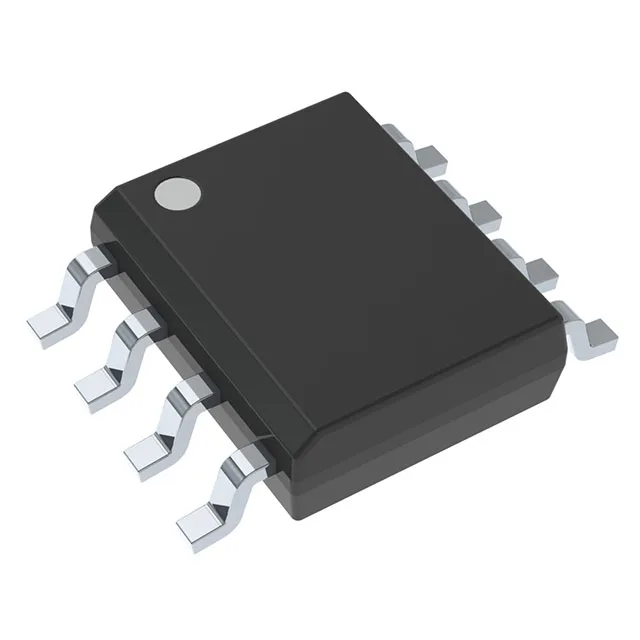
What this Hall sensor does on your board
The Texas Instruments TMCS1107A2BQDT is a single-channel Hall-effect current sensor that outputs a ratiometric voltage proportional to the sensed current. It measures both AC and DC over a ±22.5 A range with a sensitivity of 100 mV/A and ±0.5% linearity. The 80 kHz bandwidth and 6.5 µs response time suit it for motor-phase monitoring, DC-DC converter output sensing, and overcurrent detection in automotive and industrial power rails. Rated for -40°C to 125°C ambient and AEC-Q100 qualified, it handles under-hood and chassis-domain environments where temperature cycling and vibration are routine.
Ratiometric output — what it means for your ADC
Because the output scales with the 3 V to 5.5 V supply, the ratio stays constant regardless of supply drift. This lets you reference the sensor output directly to the same supply rail feeding your ADC, eliminating a separate voltage reference and keeping the measurement accurate across supply tolerances.
Automotive qualification and temperature range
AEC-Q100 qualification and the -40°C to 125°C operating range mean this part is graded for automotive stress profiles — thermal cycling, high-temperature operation, and long-life reliability targets. For a BOM destined for an ECU, battery management system, or motor drive, that grade removes the need for additional screening or derating analysis.
Lifecycle and sourcing posture
TI lists the TMCS1107A2BQDT as Active with ROHS3 compliance. No NRND or last-time-buy notice applies. For volume commitments or date-code requirements, include those in your inquiry.
