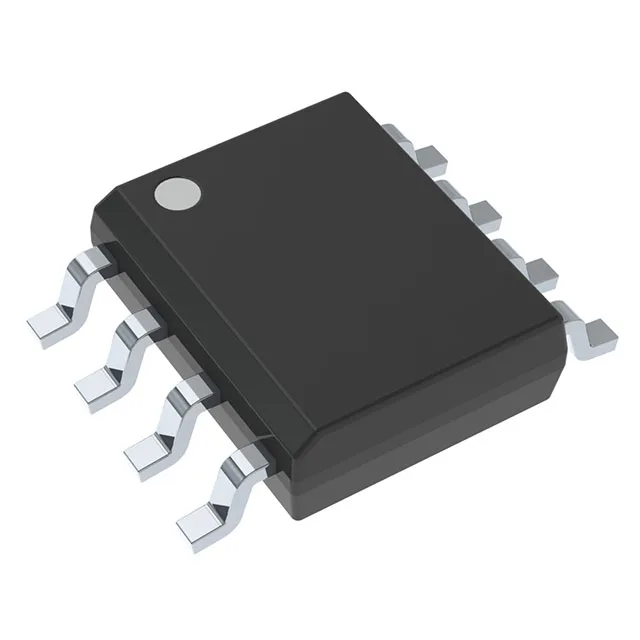
Automotive-grade Hall-effect current sensing
The Texas Instruments TMCS1100A3QDRQ1 is a single-channel Hall-effect current sensor rated for AC/DC measurement, delivering a ratiometric voltage output proportional to the sensed current. Its AEC-Q100 qualification and operating temperature range of -40°C to 125°C make it a direct fit for automotive ECU, motor-drive, and under-hood current-monitoring applications where reliability over temperature is non-negotiable.
80 kHz bandwidth — what it buys the power-stage designer
With an 80 kHz bandwidth and a 6.5 µs response time, this sensor tracks fast current transients in switching power converters and motor-phase loops. The 200 mV/A sensitivity scales the output to a usable voltage range for a 3.3 V or 5 V ADC without external amplification — match the full-scale current to the ADC input range directly. Linearity of ±0.05% keeps the transfer curve clean across the measurement span, reducing the need for multi-point calibration in production.
Supply and output — single-rail simplicity
The device operates from a 3 V to 5.5 V supply and draws a maximum of 6 mA. The ratiometric voltage output tracks the supply, so the full-scale output scales with the ADC reference — a useful feature when the same rail feeds both the sensor and the microcontroller. The 8-SOIC package is a standard footprint for current-sense ICs, and surface-mount assembly keeps the board profile low.
Lifecycle and sourcing
For volume production or BOM-line qualification, the AEC-Q100 certification and automotive grade are already documented, so no additional qualification paperwork is needed for tier-one programs.
