Each of the four amplifiers draws 60 µA of supply current, making the total quiescent draw 240 µA for the package.
Input bias current is 5 pA typical, so the part can interface with high-impedance sensors (piezoelectric, photodiode) without significant offset from bias current flowing through source resistance.
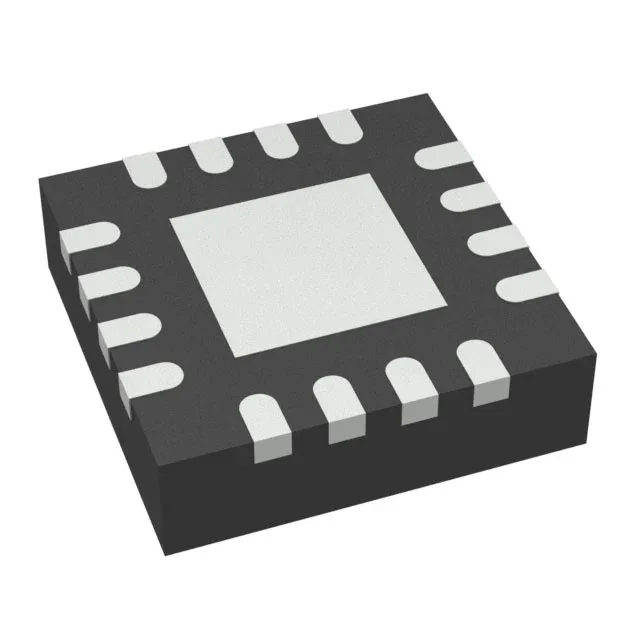
Package and thermal — 16-WQFN with exposed pad
Without that via stitch, the junction temperature rises quickly when all four channels source 40 mA simultaneously. The pad also provides a low-inductance ground return, which helps keep the supply clean in mixed-signal layouts.
For dual-sourcing, the TLV9351IDCKR is a single-channel alternative with higher bandwidth (3.5 MHz) and faster slew rate (20 V/µs), but it is not a pin-compatible drop-in — the package and channel count differ. The TLV9362IDDFR is a dual-channel sibling with 10.6 MHz GBW. Neither is a direct quad replacement; the TLV9004IRTER is the only quad in this low-power family at the 1 MHz tier.