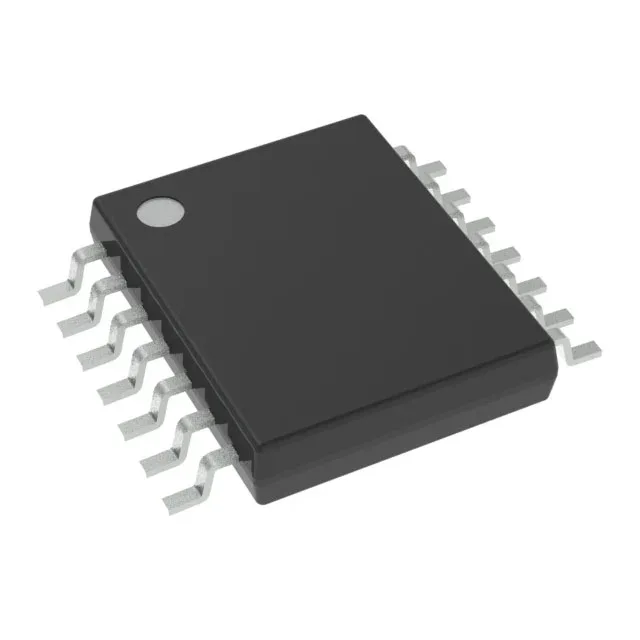
Quad op-amp for low-power signal chains
Each amplifier draws 75 µA of supply current, making the part well-suited for multi-channel sensor conditioning, battery-powered instrumentation, and industrial control loops where per-channel power budget is tight.
The 1.8 V minimum supply lets this quad op-amp operate in deeply discharged battery systems or 1.8 V logic-powered sensor interfaces, while the 5.5 V maximum keeps it compatible with standard 5 V industrial rails without needing a separate regulator. Rail-to-rail output swing at both ends of the supply means the user gets nearly the full supply range into an ADC or comparator — useful when the headroom is only a few hundred millivolts above ground.
75 µA per channel — thermal and battery budget
At 75 µA per amplifier, the total quiescent draw for all four channels is 300 µA typical. In a portable device running from a 200 mAh cell, that translates to hundreds of hours of continuous operation before the op-amps alone drain the battery.
1 MHz GBW, 0.5 V/µs slew — application fit
It is intended for DC-accurate or low-frequency AC signals: temperature sensor outputs, strain-gauge bridges, pressure transducer buffers, and audio-band filtering. The 1 pA input bias current (typical) preserves accuracy when the source impedance is high, such as in photodiode or pH probe front ends.