350 nA supply, 6 kHz GBW — the ultra-low-power analog front end
Its defining characteristic is a supply current of 350 nA typical, paired with a gain-bandwidth product of 6 kHz. That combination tells you this is not a general-purpose op-amp — it is a precision, DC-coupled, extremely low-power amplifier intended for always-on sensor conditioning, battery monitoring, and threshold detection in energy-harvested or coin-cell systems. The rail-to-rail output stage allows the full supply swing into a 12 mA load, which is enough to drive a microcontroller ADC input or a comparator directly. Input bias current is 1 pA typical, so you can use high-impedance sensors without worrying about offset drift from the bias path.
The supply span runs from 1.7 V minimum to 5.5 V maximum. That means a single Li-ion cell (3.0–4.2 V) or two alkaline cells (1.8–3.0 V) can power it without a regulator. The 1.7 V floor is low enough to run from a nearly depleted primary cell, extending system life in remote or disposable equipment. With a slew rate of 0.0025 V/µs, the output cannot track fast signals — expect a full-scale step to settle in roughly 400 µs. This part is for DC or very low-frequency signals (sub-100 Hz), not audio, not control loops, not any waveform that needs a bandwidth beyond a few hertz. The 6 kHz GBW is the open-loop gain-bandwidth product; in a unity-gain configuration the -3 dB point is 6 kHz, but in a gain-of-100 stage the closed-loop bandwidth drops to 60 Hz.
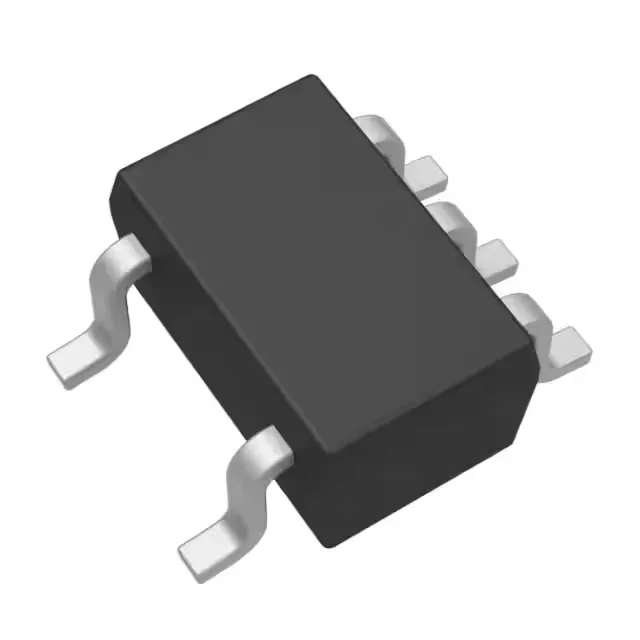
SC-70-5 package — fits tight layouts
The TLV521DCKR comes in the SC-70-5 package, a 5-pin surface-mount case that occupies roughly 2.2 mm × 2.1 mm. For a board with multiple sensor channels, the small size lets you place an amplifier right at the sensor output, keeping the analog trace short before the ADC.
For a BOM engineer, this is a safe selection for a new design — no risk of a mid-production EOL notice that forces a respin.