1 µA supply current — the part that makes the battery budget work
At that quiescent draw, it is one of the lowest-power rail-to-rail output amplifiers in a SOT-23-5 footprint, designed for applications where every microamp on the analog rail is budgeted against battery life. The 5.5 kHz gain-bandwidth product and 0.002 V/µs slew rate tell you immediately this is not a high-speed signal chain part — it is a DC-accurate, near-static amplifier for sensor conditioning, threshold detection, and battery monitoring where the signal changes slowly or not at all. The supply span runs from 2.5 V up to 12 V, covering single-cell Li-ion through unregulated 12 V industrial rails without needing an extra LDO. Input bias current is 100 pA, and input offset voltage is 600 µV — both adequate for non-precision DC loops where the priority is current consumption, not sub-millivolt accuracy.
5.5 kHz GBW — what that means for signal bandwidth
With a gain-bandwidth product of 5.5 kHz, the TLV2241IDBVT is a DC-to-slow-signal amplifier. At a closed-loop gain of 10, the usable bandwidth drops to roughly 550 Hz. This suits temperature sensing (thermistor, RTD), battery voltage monitoring, comparator-threshold generation, and other quasi-static analog functions. It will not track a 1 kHz audio signal or a switching regulator's ripple — that is not what this part is for. The 0.002 V/µs slew rate reinforces the same boundary: large-signal steps at the output take milliseconds to settle. For a 1 V output step, the slew-limited risetime is about 500 µs. The part is stable and predictable within that envelope, but the designer must not expect fast transient response.
SOT-23-5 package and temperature grade
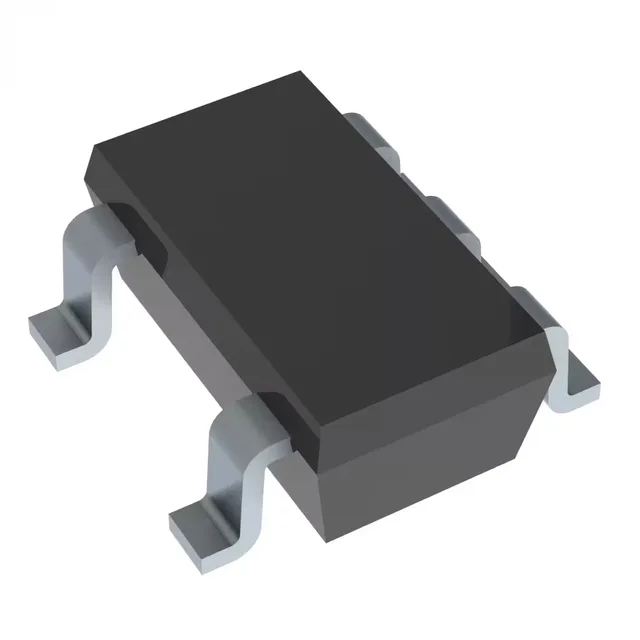
The TLV2241IDBVT is supplied in a 5-pin SOT-23 (SC-74A case code), occupying roughly 3 mm × 3 mm of board area.