Micropower op-amp for battery and sensor apps
Its standout spec is the 1 µA supply current — that is the whole amplifier running, not a sleep mode. The trade-off is a 5.5 kHz gain-bandwidth product and a 0.002 V/µs slew rate, so this part is strictly for DC or very low-frequency signals: conditioning a thermocouple, buffering a pressure-sensor output, or level-shifting a slow analog reference.
What the 1 µA supply means for your BOM
That 1 µA supply current is the reason you pick this part over a standard 500 µA op-amp. In a battery-powered sensor node running for a year on a CR2032, shaving 499 µA per amplifier doubles or triples the shelf life. Input bias current is 100 pA — fine for high-impedance sources like pH probes or photodiode amplifiers, though the 600 µV input offset means you will want to calibrate or tolerate a few millivolts of DC error.
Package and field-fit
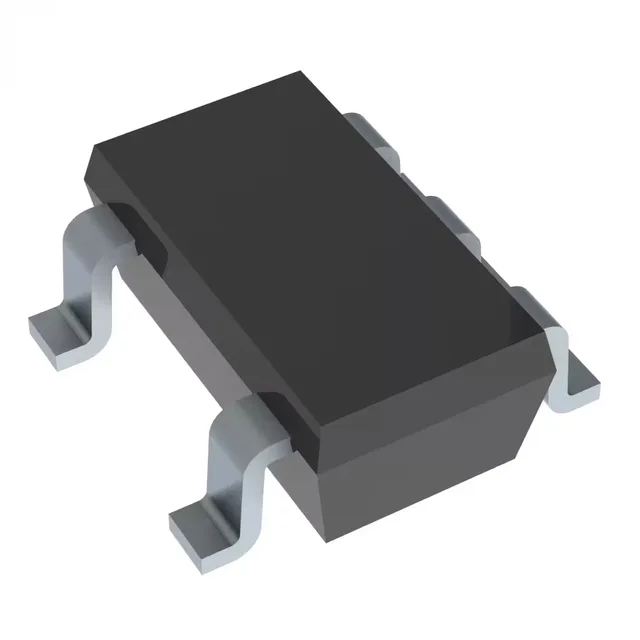
The TLV2241IDBVR comes in a 5-pin SOT-23-5 (SC-74A) surface-mount package. That is a small, hand-solderable footprint — a field-service tech with a fine-tip iron and some flux can swap it on site without a hot-air station. No exposed pad, so no via-stitch thermal management needed.