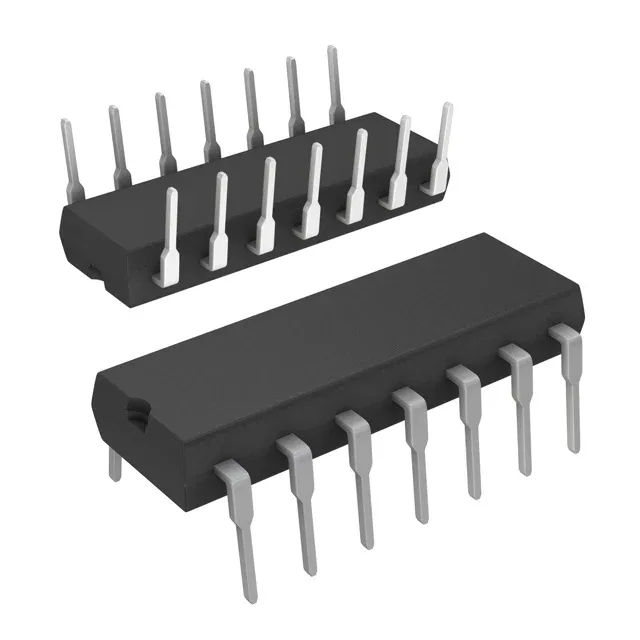
Quad CMOS op-amp for low-frequency, low-power signal chains
The 57 µA total supply current across all four amplifiers makes it a strong candidate for battery-powered or energy-harvesting sensor interfaces where every microamp is budgeted.
That 3 V floor lets it run directly off a lithium coin cell or a 3.3 V rail without a boost converter, while the 16 V ceiling covers industrial ±5 V or ±8 V rails. The CMOS input stage draws only 0.7 pA of input bias current — negligible for high-impedance sources like pH probes, photodiode transimpedance stages, or precision voltage dividers.
Output drive and temperature grade
For extended-temperature designs, the TLC27L4 series includes industrial-grade variants.
The through-hole 14-DIP package is a legacy footprint, but TI continues to manufacture it, so there is no forced migration to a surface-mount alternative.