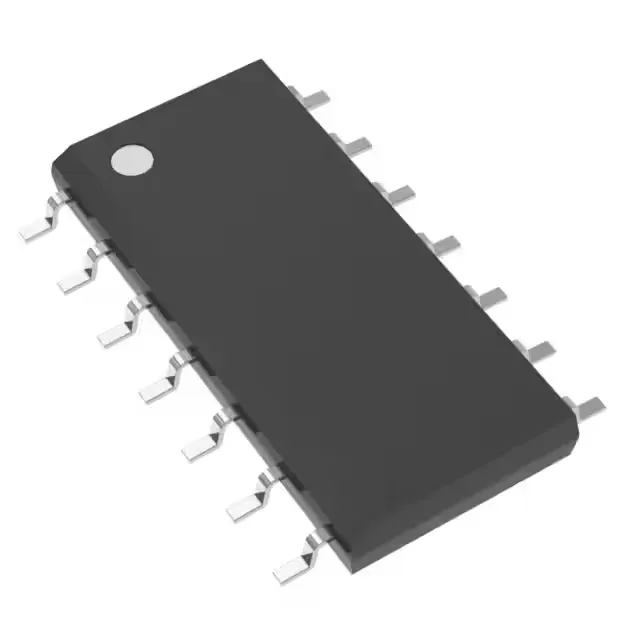
What this quad op-amp does on your board
The TLC27L4ACDR: The gain-bandwidth product of 110 kHz and slew rate of 0.05 V/µs tell you this is a DC-to-slow-signal part: think thermocouple conditioning, photodiode amplification, or sensor buffering, not audio or fast control loops.
The 57 µA supply — what it buys you
At 57 µA total for four amplifiers, the TLC27L4ACDR sits in the ultra-low-power tier of CMOS op-amps. That current budget includes all four channels, so a multi-stage filter or a quad-sensor interface can run continuously without draining a coin cell. The trade-off is speed: the 110 kHz GBW and 0.05 V/µs slew rate limit you to signals below roughly 10 kHz for decent gain accuracy. For a temperature monitor or a pressure-sensor bridge that updates at a few hertz, this is exactly the right part.
Input bias current: 0.7 pA
The CMOS input stage delivers a typical input bias current of 0.7 pA. That matters when your source impedance is high — think pH probes, piezoelectric sensors, or high-megohm resistor dividers. The voltage offset is 1.1 mV typical, which is reasonable for this class; if you need sub-millivolt precision, you'd step to a chopper-stabilized part, but for general-purpose low-frequency work the offset is fine.