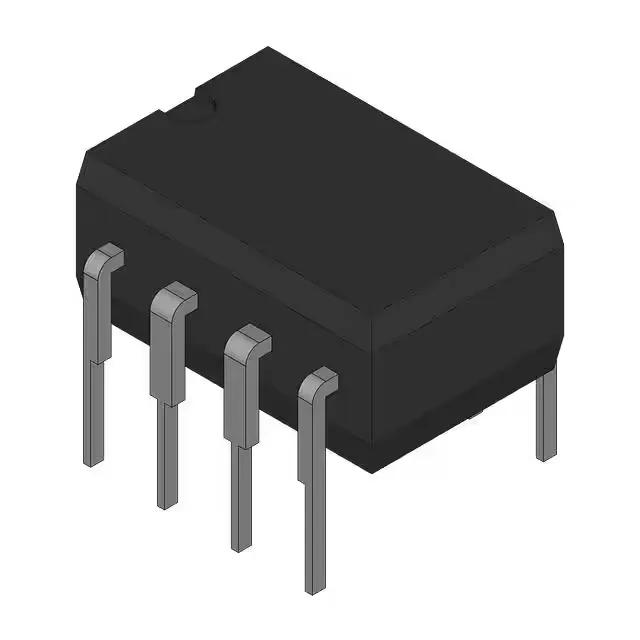
Precision DC amplifier in a DIP — what the 0.6 µV offset buys you
Its 0.6 µV typical input offset voltage — a figure that would be a maximum on most precision amps — means you can amplify microvolt-level signals without nulling pots or digital calibration at the board level. The chopper-stabilized architecture keeps that offset from drifting with temperature and time, which is the whole point of the zero-drift class. With a 1.9 MHz gain-bandwidth product and 3.1 V/µs slew rate, it is not a fast amplifier, but it is fast enough for low-frequency instrumentation, thermocouple conditioning, and strain-gauge bridges where the DC precision is the bottleneck.
Through-hole package — legacy footprint, still in active production
The TLC2652CP lives in an 8-DIP (0.300", 7.62mm) body with the supplier device package 8-PDIP. That is a through-hole footprint — the kind you socket on a prototype board, repair a legacy instrument, or run in a low-volume production line that has not switched to SMT. But the DIP format is a mature product stage; if your BOM depends on this package, keep an eye on PCNs because the industry trend is toward smaller surface-mount alternatives.
The TLC2652CP runs from a single or split supply spanning 3.8 V to 16 V total. That 3.8 V minimum means it works on a 5 V rail with headroom, but not on a 3.3 V rail — you need at least 3.8 V across the supply pins. Quiescent current is 1.5 mA typical, reasonable for a precision amplifier that is not battery-powered. The input bias current of 4 pA is the other headline number: it lets you interface with high-impedance sources like pH probes or photodiode sensors without the bias current creating a voltage drop across the source resistance. Output can source or sink 50 mA, enough to drive an ADC input or a modest cable.
That rules out outdoor enclosures, engine bays, or any environment that sees freezing or sustained heat. If your design lives in a conditioned lab, test equipment rack, or office appliance, this range is fine. For industrial or automotive temperature exposure, you would need a different suffix in the TLC2652 family.