730 kHz GBW and 1 pA input bias — what that buys you
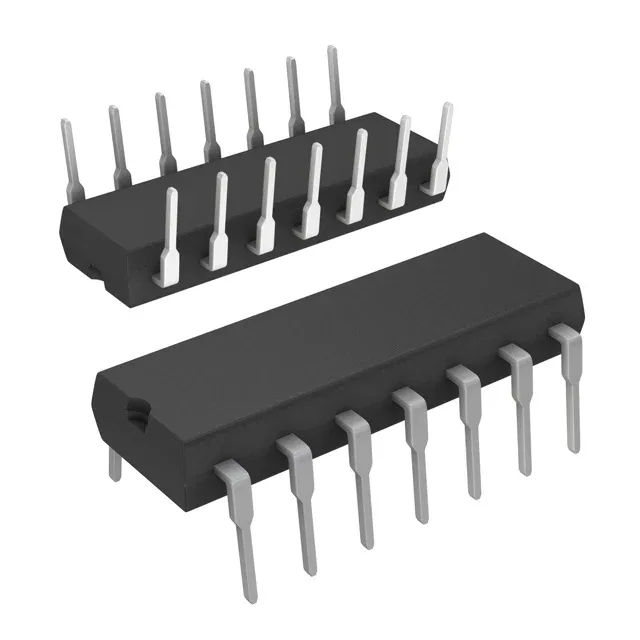
The TLC2264IN is a Texas Instruments quad general-purpose op-amp from the LinCMOS™ series, packing four amplifiers in a single 14-pin DIP. Its 730 kHz gain-bandwidth product and 0.55 V/µs slew rate cover audio-frequency filtering, sensor buffering, and low-speed ADC drive without breaking a sweat. The 1 pA input bias current is the headline feature for anyone conditioning high-impedance signals — think photodiode transimpedance stages, pH probe buffers, or thermocouple amplifiers where bias current error would swamp the measurement.
Supply current and thermal range
Total supply current is 800 µA for all four channels — 200 µA per amplifier — which puts this squarely in the micropower category. That matters for battery-powered instruments or multi-channel data-acquisition boards where the op-amp power budget is a line item. Supply voltage runs from 4.4 V up to 16 V, meaning it works on a 5 V rail with headroom or a standard 12 V industrial bus, but not on a 3.3 V rail without a boost converter.
14-DIP package — rework-friendly but board-area hungry
The 14-DIP (0.300" width) through-hole package is a breadboard and prototyping natural — you can socket it, swap it, and rework it with a standard soldering iron. That same footprint takes up more board area than an SOIC-14 or TSSOP-14, so it is not the choice for a dense production board.
The LinCMOS™ series has broad distribution support, so this part is straightforward to source through independent channels. For dual-sourcing resilience, the TLV9351IDCKR is a single-channel CMOS rail-to-rail op-amp with a wider 3.5 MHz GBW and 20 V/µs slew rate, but it comes in a surface-mount package — not a pin-for-pin drop-in for the quad DIP.