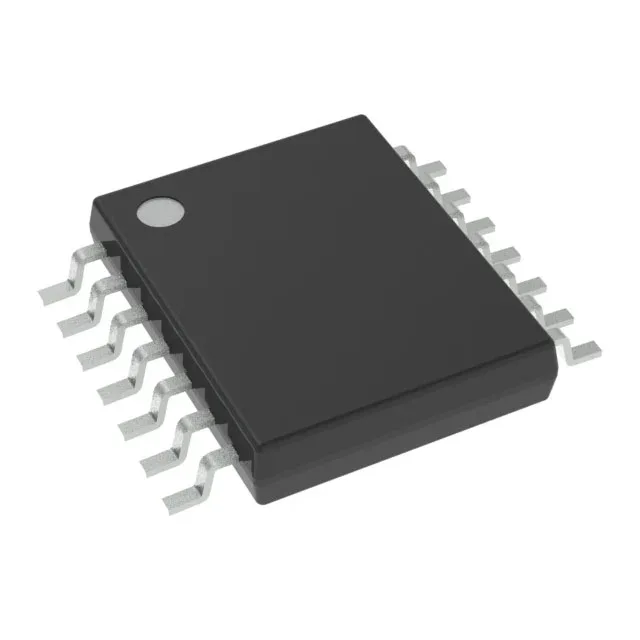
The Texas Instruments TLC2264CPW is a quad-channel, general-purpose CMOS op-amp from the LinCMOS™ series. It combines rail-to-rail output swing with a 730 kHz gain-bandwidth product and a 0.55 V/µs slew rate, drawing 850 µA total from a 4.4 V to 16 V supply. The 1 pA input bias current suits it for high-impedance sensor interfaces, photodiode amplifiers, and battery-monitoring circuits where the signal source cannot drive a bipolar input stage.
The 730 kHz gain-bandwidth product sets the small-signal bandwidth: a non-inverting stage with a gain of 10 closes a loop bandwidth of about 73 kHz. The 0.55 V/µs slew rate limits the large-signal response — a 5 V peak-to-peak output step slews in roughly 9 µs, which caps the full-power bandwidth near 20 kHz. For audio or low-frequency instrumentation this is adequate; for fast pulse amplification or video buffers it is not. The 300 µV input offset voltage (typical) and 1 pA bias current keep the DC errors low enough for 12-bit systems with moderate source impedance.
Package and footprint: 14-TSSOP
The 50 mA per-channel output current capability is enough to drive moderate loads, but the package's thermal impedance means sustained output current near that limit on all four channels simultaneously will push the junction temperature above the 70°C ambient rating; derate accordingly.
For dual-sourcing or a higher-speed alternative, the TLV9351IDCKR (3.5 MHz GBW, 20 V/µs slew rate, single channel) is a different speed grade and channel count — not a pin-compatible substitute.