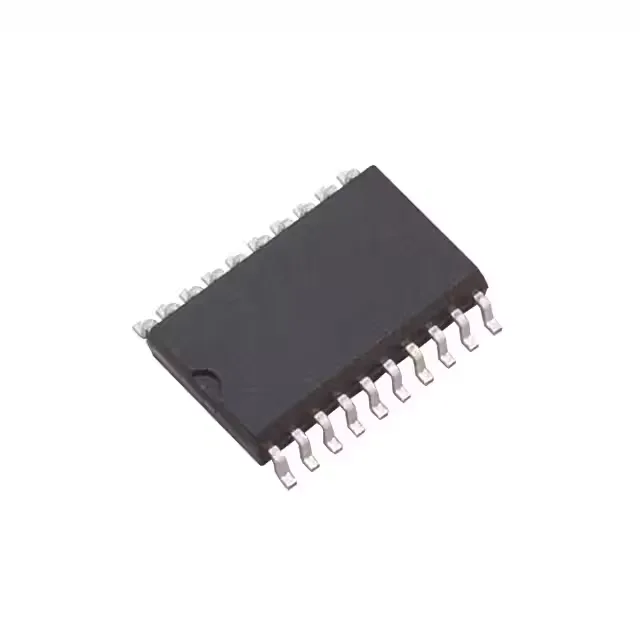
Active buffer for 3.3V buses — no scavenger hunt needed
The 32mA source / 64mA sink capability per output gives it the muscle to handle moderate fan-out on a shared data or address bus — think driving a handful of CMOS inputs plus a few termination resistors without the signal edges rounding off.
The scorch-mark test: what actually fails on these
In the 74LVTH family, the usual failure signature on a dead board is a shorted output pin to ground or supply — the 3-state driver latches up if an input exceeds the rail by more than a diode drop. If you're troubleshooting a board where the buffer ran hot and the scorch mark tells you which package corner cooked, the 20-SOIC wide-body footprint is standard enough that you can pull a replacement from stock without re-spinning the layout.
The 2.7V to 3.6V supply range means this part works with a 3.3V rail that droops under load, or with a 3.0V battery-backed supply in a redundant system. At 3.3V nominal, the 32mA high-level output current and 64mA low-level output current give you roughly 10 standard LSTTL loads per output — enough for a memory address bus or a bank of control signals. The 3-state outputs let you wire-OR multiple buffers onto the same bus without contention, as long as only one enable is active at a time. If you're running the part near its maximum drive, watch the total package dissipation: at 64mA per output on four channels sinking, you're looking at about 200mW in the die — fine for the SOIC-20 with reasonable airflow, but check the thermal budget if the ambient hits 85°C.
Package and footprint — the 20-SOIC wide-body reality
The SN74LVTH241DW comes in a 20-pin SOIC wide-body package (0.295-inch body width, 7.50mm). This is the same footprint as the standard SOIC-20W used across the 74LVTH and 74LVC families, so if your board already has a footprint for a 74LVTH16245 or 74LVC244A in the wide SOIC, this part drops in without a layout change. Surface-mount only, no through-hole option in this package.
Lifecycle — still an active line, no LTB pressure
That said, always check the latest TI PCN database before a production release — the active status is current, but no semiconductor line is guaranteed forever.