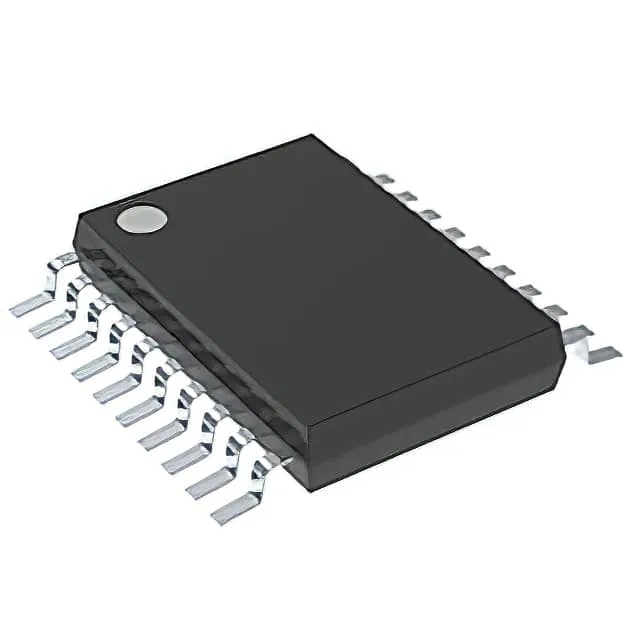
Each of the two elements handles four bits, giving you an 8-bit inverting bus driver in a single 20-TSSOP package. The 3-state outputs let you connect it directly to a shared data bus — memory address lines, peripheral chip selects, or a microcontroller port — without external bus switches or extra logic.
Output drive: 32 mA sourcing, 64 mA sinking
The asymmetric drive — 32 mA per output when sourcing, 64 mA when sinking — is the spec that determines how many loads this buffer can drive and at what speed. The higher sink current is typical for TTL-compatible logic where the output pulls down against a pull-up or a terminated line. For a 3.3 V backplane or a memory bus with series termination, the 64 mA sink gives you clean low-level edges into a 50 Ω or 33 Ω load. The 32 mA source side still drives four to eight standard 74LVTH inputs without fan-out concerns. If your design needs symmetric drive or non-inverting logic, you would look at the 74LVTH162245 family instead.
It is not automotive-grade (no AEC-Q100), so skip it for under-hood or chassis-domain designs. For an unheated enclosure in a northern-climate factory, the -40°C cold start is fine; the 85°C top end covers most convection-cooled cabinets. If your board sits near a hot power stage or in a sealed enclosure, budget for the junction temperature rise from the 64 mA sink current.