What this 8-bit transceiver does on the bus
It provides bidirectional data flow between two 8-bit buses (A and B ports) with a direction control pin, and the 3-state outputs let you isolate the bus when the device is deselected — essential for shared backplanes or multiplexed data paths.
Symmetrical 24 mA source and sink capability means this transceiver can drive a heavily loaded backplane trace or fan out to multiple CMOS inputs without needing an external line driver. At 3.3 V you get clean edges into a 50 pF load; at 1.8 V the edge rate slows, but the drive current stays at 24 mA, so the signal integrity depends more on trace impedance than on supply droop. If your bus runs at 1.65 V, budget extra propagation delay — the 74LVC family slows as the rail drops.
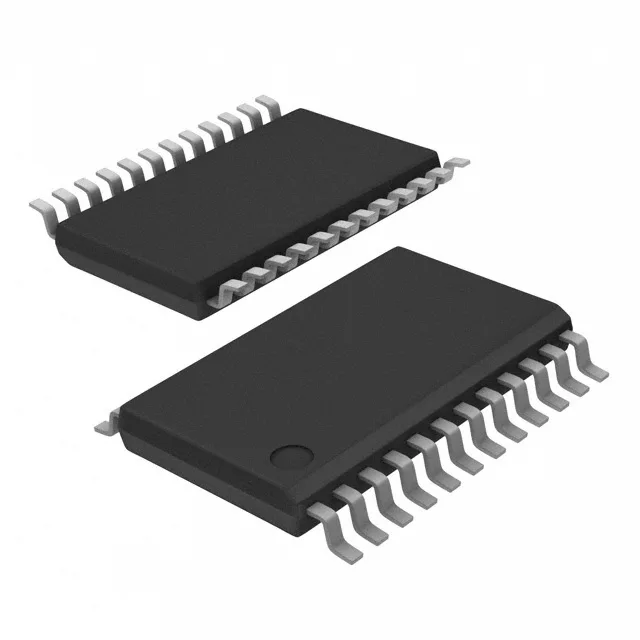
Package and footprint: 24-TSSOP
Housed in a 24-TSSOP package with a 4.40 mm body width and 0.65 mm pin pitch. This is the standard narrow-body TSSOP footprint for octal bus functions — same land pattern as the 74LVC245 and 74LVC541 in the same package. The 0.173 inch (4.40 mm) width keeps the board footprint compact, but the fine pitch means your solder paste stencil aperture needs careful sizing to avoid bridges between adjacent pins.
The 3.6 V absolute maximum supply means you cannot run this on a 5 V bus without a series resistor or a level shifter.
ROHS3 compliant (lead-free, no exemptions). No PCN or LTB dates have been issued for this specific order code.
Sourcing posture
No minimum order quantity restrictions beyond standard reel increments. For urgent BOM fills, the 24-TSSOP package is common enough that alternative date codes or reel quantities can usually be sourced without requalification.