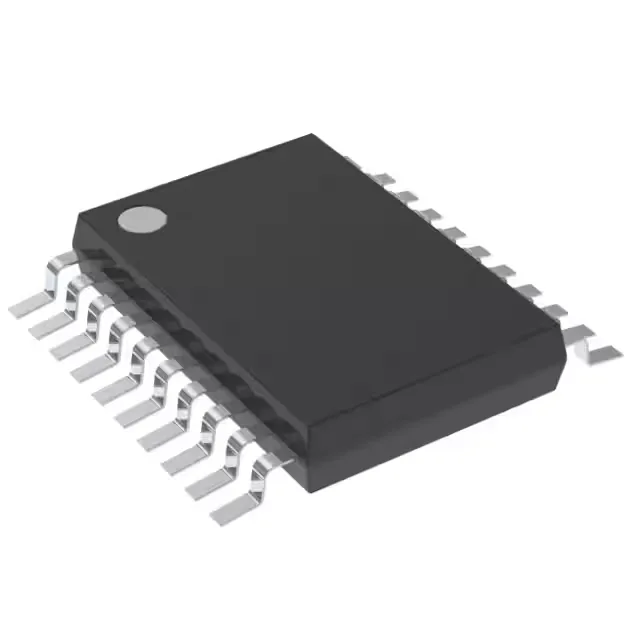
Bus transceiver for mixed-voltage backplanes
It provides bidirectional data flow between two buses with a direction (DIR) control and output-enable (OE) for 3-state isolation. The part operates from 1.65V to 3.6V, making it suitable for 1.8V and 3.3V logic domains, and delivers 24 mA sink and source per channel — enough to drive a lightly loaded backplane segment or a handful of CMOS inputs without a buffer. The active lifecycle status means no end-of-life risk for production programs starting now.
Supply rail and drive — what fits
The 1.65V minimum supply lets this part bridge between a 1.8V microcontroller and a 3.3V peripheral without a level shifter, as long as the DIR and OE pins are referenced to the same VCC. If your bus needs more than 24 mA per line, step up to the 74ABT family (32 mA) but note the 4.5V minimum supply and 85°C temperature ceiling. This is not a 5V-tolerant part — the absolute maximum input voltage tracks VCC + 0.5V per the 74LVC datasheet convention. Driving a 5V logic signal into any pin risks latch-up or damage. Use the SN74LVC245A if you need 5V-tolerant inputs (the 'A' suffix variant adds that feature).
Sourcing posture
The 20-SOIC wide-body package is a standard TI offering, so alternate date codes and reel quantities are accessible through the broker channel without franchise restrictions.