Quad buffer with 3-state outputs for mixed-voltage buses
Each of the four elements buffers one bit, and the 3-state enable lets you disconnect the outputs from a shared bus when the buffer is not driving. With 24 mA source and sink capability per output, it can drive typical CMOS loads and short PCB traces without needing a separate line driver.
Supply voltage range — which logic families it talks to
The 1.65V to 3.6V supply range means this buffer works directly with 1.8V, 2.5V, and 3.3V logic without level translation. At 3.3V it is a drop-in for legacy 74HC or 74HCT sockets in new low-voltage designs, though the 74LVC inputs are not 5V-tolerant — keep the input signals within the supply rails. The wide range also lets you run the same BOM across boards with different core voltages, reducing line-item count.
Temperature grade — where it survives
The 125°C ceiling also covers the self-heating margin when all four buffers are driving 24 mA simultaneously in a confined space.
Output drive — what 24 mA per channel gets you
Each of the four outputs can source or sink 24 mA. For bus applications, the 3-state outputs let multiple buffers share a common data line — the enable pin per element gives fine-grained control over which channel drives at any moment.
Package and hand-soldering
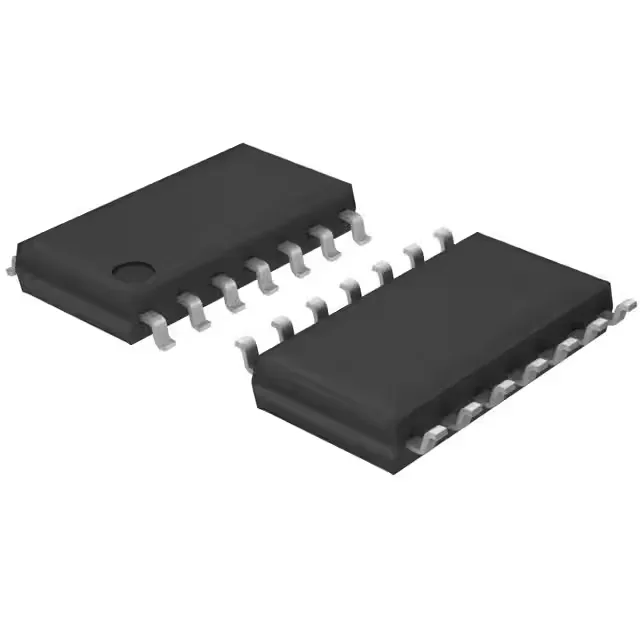
The 14-SOIC package with 5.30 mm body width uses the standard 1.27 mm pin pitch. The wider body means the pins are spaced far enough apart for hand-soldering with a fine-tip iron — no hot-air station required. The surface-mount footprint is common across many 14-pin SOIC logic parts, so a single PCB land pattern covers multiple alternate buffers.