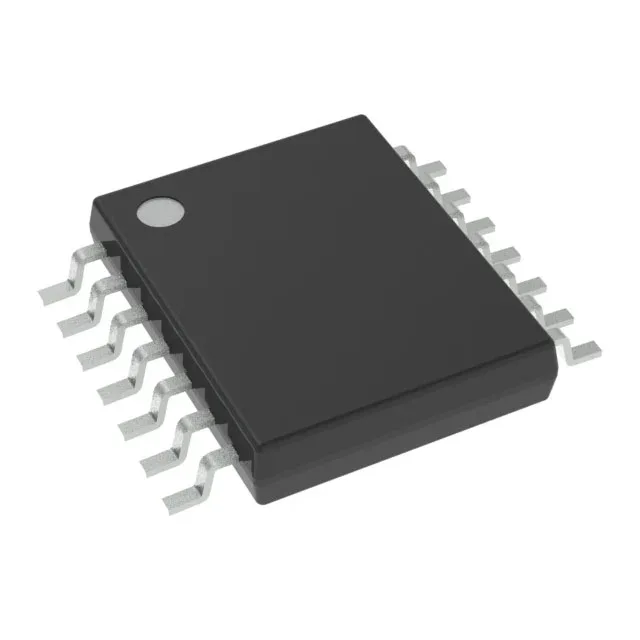
Each of the six independent inverters can sink up to 24 mA, making the part useful for driving indicator LEDs, relay coils, or pulling signal lines low in mixed-voltage systems. The open-drain output means the high-side is floating — you pull it up externally to whatever voltage the downstream logic needs, up to the device's 3.6 V supply limit. The supply range spans 1.65 V to 3.6 V, so it works directly off a 1.8 V, 2.5 V, or 3.3 V rail without a separate regulator. Propagation delay is 3.7 ns typical at 3.3 V with a 50 pF load — fast enough for most logic-level translation and bus-interface tasks in an automotive ECU or body controller.
Open-drain output — the so-what for your design
The open-drain architecture means the output transistor only pulls the pin low; the high state is achieved through an external pull-up resistor connected to the target logic voltage. This is the standard trick for level-shifting a 3.3 V logic signal down to 1.8 V or up to 5 V (within the 3.6 V supply limit). It also lets multiple open-drain outputs share a common pull-up for wired-OR configurations — useful for interrupt lines or bus-request signals where any device can assert the line low. The 24 mA sink capability is generous for a logic gate; you can drive a standard LED directly through a current-limiting resistor without a separate transistor.
The AEC-Q100 qualification means it is released for automotive production programs and carries the full PPAP documentation package from TI.