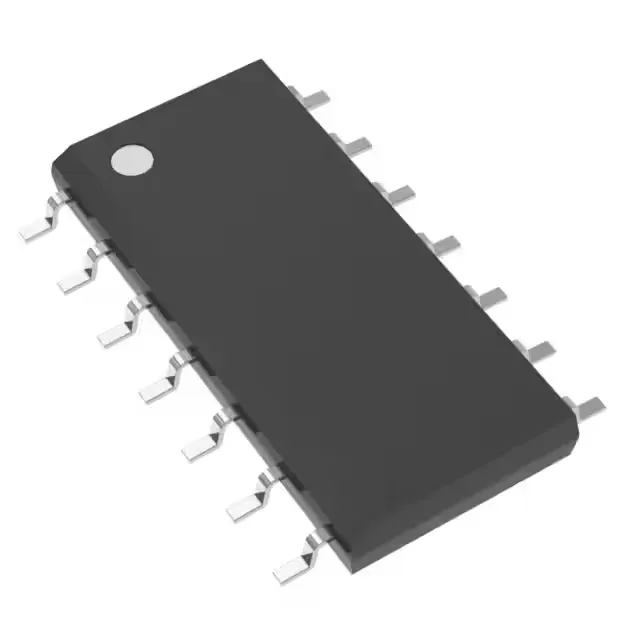
What this hex Schmitt-trigger inverter does on the board
The Texas Instruments SN74LS14DR is a hex inverter with Schmitt-trigger inputs from the 74LS bipolar low-power Schottky family. It packs six independent inverters into a 14-SOIC package, each with a single input and a Schmitt-trigger hysteresis that cleans up slow or noisy edges — useful for debouncing switches, squaring up oscillator waveforms, or interfacing with sensors that produce ragged transitions.
Supply range of 4.75V to 5.25V ties it to classic 5V TTL rails — not a 3.3V or 1.8V logic part, so confirm your rail before fitting it into a mixed-voltage design. Propagation delay of 22ns at 5V with a 15pF load sets the timing budget for the signal path. In a 10 MHz clock chain you lose about a quarter-cycle per gate; cascading multiple stages needs a timing analysis. Output drive is rated 400µA sourcing and 8mA sinking — enough to drive a standard TTL load or a low-power LED indicator, but not a high-current relay or bus without a buffer. Input logic thresholds are 0.5V low and 1.9V high, with the Schmitt hysteresis providing noise immunity of about 1.4V typical. That margin handles a slowly rising RC waveform or a long PCB trace with crosstalk.