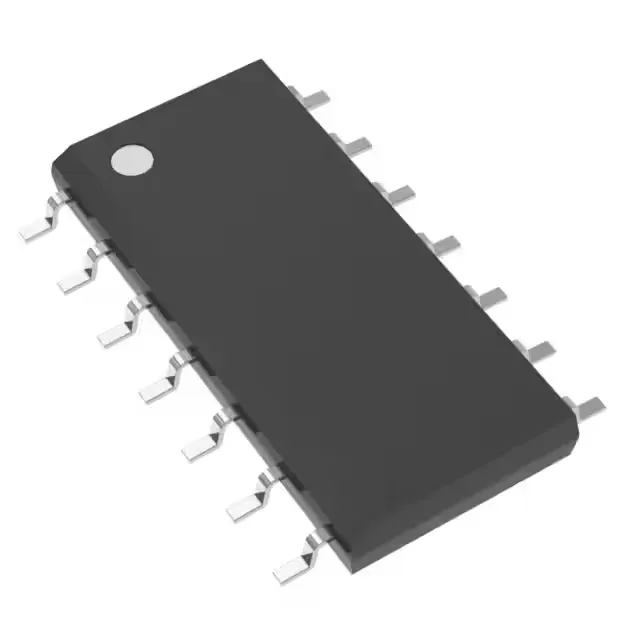
Texas Instruments SN74HCT14DT — DC-DC Power Modules

SN74HCT14DT 74HCT Hex Inverter with Schmitt-Trigger Inputs

MPNSN74HCT14DT
End of Life

Texas Instruments 74HCT series hex inverter with Schmitt-trigger inputs, 6 circuits, 1 input per channel, 14-SOIC package, 4.5V to 5.5V supply, -40°C to 85°C operating range, 30ns max propagation delay at 5.5V and 50pF.

$1.16Ref. price · indicative, final on quote
Packaging14-SOIC (0.154", 3.90mm Width)
StockContact for availability
MOQ1 pcs
  • 100% new & originalTraceable channels only — no refurbs, no pulls, no remarked parts.
  • Date & lot codes on quoteStated per line before you commit; label photos on request.
  • MSL-compliant ESD packingMoisture-sealed bags with indicator cards; reels photo-verified.
  • PayPal buyer protectionPay by T/T, PayPal or Payoneer — card payments covered end to end.

Specifications

SN74HCT14DT Technical Specifications
ParameterValue
Series74HCT
Logic typeInverter
Mounting typeSurface Mount
Voltage4.5V ~ 5.5V
Current - quiescent2 µA
Current - output high, low4mA, 4mA
Number of inputs1
Operating temperature-40°C ~ 85°C
PackageTape & Reel (TR); Cut Tape (CT)
FeaturesSchmitt Trigger
Case14-SOIC (0.154\", 3.90mm Width)
Number of circuits6
Input logic level - low0.5V ~ 0.6V
Input logic level - high1.9V ~ 2.1V
Max propagation delay @ v, max CL30ns @ 5.5V, 50pF

Product details

Six Schmitt-trigger inverters in a 14-SOIC — what the SN74HCT14DT brings to the board

The Texas Instruments SN74HCT14DT packs six independent inverter gates, each with a Schmitt-trigger input, into a 14-SOIC package. It runs from a 4.5V to 5.5V supply — the classic HCT logic family that is TTL-compatible on the input side while using a CMOS output structure. The Schmitt-trigger hysteresis gives clean switching on slowly changing or noisy input signals, with defined low-level thresholds at 0.5V to 0.6V and high-level thresholds at 1.9V to 2.1V. Propagation delay maxes out at 30ns into a 50pF load at 5.5V, and each output can source or sink 4mA. The operating temperature range is -40°C to 85°C, covering industrial and most commercial environments.

Schmitt-trigger inputs — why the hysteresis matters

Unlike a plain unbuffered inverter, the SN74HCT14DT's Schmitt-trigger inputs reject input noise and slow edges. The low-to-high and high-to-low thresholds are separated by about 1.3V of hysteresis, so a noisy or slowly rising signal from a switch, sensor, or RC oscillator won't cause multiple transitions or oscillation at the output. This is the part you reach for when cleaning up a bouncy pushbutton or squaring up a slow ramp from an external capacitor.

Active production, ROHS3 compliant — no LTB clock ticking

The SN74HCT14DT carries an Active product status and is ROHS3 compliant. There is no last-time-buy notice or obsolescence watch on this part, so it remains a safe choice for both new designs and ongoing production.

14-SOIC footprint — layout and assembly notes

The 14-SOIC package (3.90mm body width, 0.154" pitch) is a common, widely supported footprint. Surface-mount assembly is straightforward with standard reflow profiles. The device is MSL 1 per the 74HCT family typical rating — no bake-out required before reflow unless the moisture-barrier bag has been compromised. For rework, standard hot-air profiles for SOIC-14 work fine; the package is robust enough for hand-soldering with a fine-tip iron.

Frequently asked questions

What is the difference between SN74HCT14D and SN74HCT14DT?

The 'T' suffix on the SN74HCT14DT indicates tape-and-reel packaging, while the SN74HCT14D (without the 'T') typically ships in tubes or other packaging formats. The silicon and electrical specifications are identical. Choose the 'DT' variant for automated pick-and-place assembly lines that require tape-and-reel input.

Can I replace SN74HCT14DT with SN74HC14D?

The SN74HC14D is a functionally equivalent hex Schmitt-trigger inverter, but it operates on standard CMOS logic levels rather than TTL-compatible HCT levels. The HC variant has different input threshold voltages (typically 1.5V to 3.5V at 5V supply) compared to the HCT's TTL-compatible thresholds (0.5V to 2.1V). If your driving logic is TTL-level (e.g., from a 5V bipolar TTL output), the HCT version is the correct choice. For CMOS-only drive, the HC variant may work, but verify the input thresholds against your source logic.