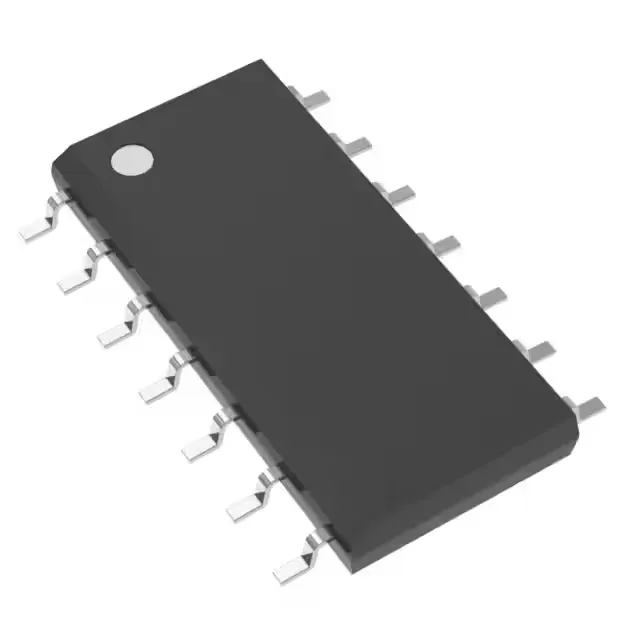
74F dual 4-input NAND — what this gate does on the board
The Texas Instruments SN74F20D is a dual 4-input NAND gate from the 74F fast logic family, packaged in a 14-SOIC (0.154" body width, 3.90 mm). It integrates two independent NAND circuits, each with four inputs, in a single surface-mount package.
Propagation delay and what it buys you
At 6 ns max propagation delay (measured at 5 V supply, 50 pF load), this gate keeps signal paths tight. In a 5 V system clocked at 50 MHz, that delay is roughly one-third of a clock period — enough headroom for a single gate stage in a critical path, but stack two or three in series and you eat the timing budget. The 74F family is faster than 74LS or 74ALS; the SN74ALS11ANS, for comparison, lists 13 ns at the same test conditions. If your board already runs 74F elsewhere, this part matches the family timing profile.
Package and rework — 14-SOIC is a friendly footprint
The 14-SOIC narrow body (3.90 mm width) is a standard gull-wing leaded package. The 14-SOIC footprint is shared across many 74F and 74LS logic gates, so a PCB layout for this part can often accommodate a drop-in alternative if supply shifts.
The ROHS3 rating covers all six restricted substances plus the four phthalates — no exemption expiry to track. The 74F series has been in production for decades, so the risk of a sudden EOL is low, but as with any mature logic family, monitor TI's PCN feed if the design has a multi-year production run.
The SN74F20D is a current-production, widely stocked logic gate. Through independent distribution, we source it against an RFQ and confirm availability and current pricing at quote time. Because it is Active and ROHS3 compliant, there is no LTB inventory to chase and no date-code risk from surplus stock. If you are dual-sourcing a 74F NAND gate, the SN74F00DR (quad 2-input NAND, same 74F family, same 14-SOIC footprint) is a functional alternative for simpler gating, though it uses four 2-input gates instead of two 4-input gates — check your schematic's input count before swapping.