0.8V to 3.6V supply — one buffer for multiple voltage domains
Its supply range from 0.8V to 3.6V means this single part can buffer signals on 1.2V, 1.8V, 2.5V, or 3.3V rails without needing a level translator at the input — handy for mixed-voltage designs where a sensor output at 1.8V feeds a 3.3V logic input. Each output can source or sink 4mA, enough to drive a single CMOS load or a short LED indicator.
Schmitt-trigger input — why it matters for real-world signals
The Schmitt-trigger input provides hysteresis, which means it won't oscillate or produce false edges when the incoming signal is noisy or has a slow rise time. That's the difference between a clean pushbutton debounce and a glitchy counter. If your design routes a long PCB trace from a sensor or a mechanical switch, this buffer cleans up the edge before it hits the downstream logic.
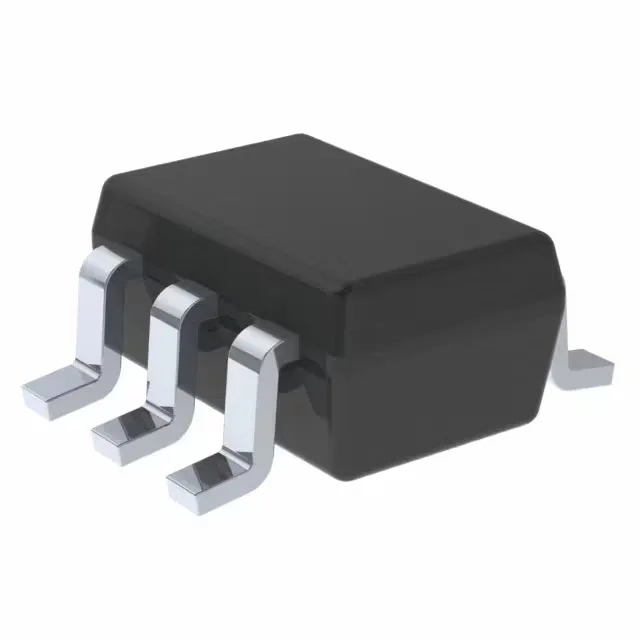
SC-70-6 footprint — board-area reality
The SC-70-6 (also known as SOT-363) package is tiny — roughly 2.0 mm × 1.25 mm — which saves real estate on dense PCBs. Surface-mount only, so hand-prototyping requires a fine-tip iron or hot-air rework. The supply voltage tolerance down to 0.8V means decoupling is less critical than with older 5V logic, but a 0.1 µF ceramic right at the pin is still good practice.
For new designs this is a safe selection; for existing BOMs it means no urgent re-qualification needed.