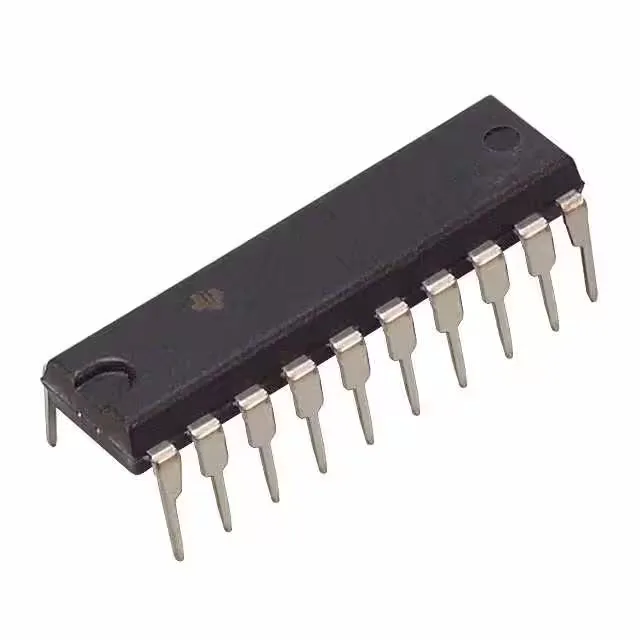
74AS octal buffer — what this part is
The Texas Instruments SN74AS241AN is a 74AS-series non-inverting octal buffer with 3-state outputs, packaged in a 20-pin DIP (0.300" body, 7.62 mm pitch) for through-hole mounting. It contains two independent elements of four bits each, giving eight total buffer channels. The 3-state outputs allow the device to be placed on a shared bus without contention — when the output enable is inactive, the outputs go high-impedance and effectively disconnect from the bus.
Output drive — 15 mA sink, 64 mA source
The output current rating of 15 mA for a logic high and 64 mA for a logic low determines how many standard TTL or CMOS inputs this buffer can drive. At 64 mA sink capability, each output can handle a heavy fan-out of LS-TTL loads or drive a terminated backplane line. The asymmetric drive (stronger low than high) is typical of bipolar logic families and matters when interfacing to CMOS inputs that have different threshold voltages.
Supply and temperature — 5 V nominal, commercial range
Operating from a 4.5 V to 5.5 V supply, this buffer is designed for standard 5 V TTL systems. Not rated for automotive or extended industrial temperature ranges.
Through-hole DIP — legacy and prototyping fit
The 20-pin DIP (20-PDIP) package is a through-hole footprint that suits breadboard prototyping, socketed designs, and legacy PCB maintenance. It occupies more board area than a surface-mount SOIC or SSOP but is easier to hand-solder and replace in rework. For new high-density designs, a surface-mount 74AS variant would be the more space-efficient choice.
Lifecycle — active, no LTB risk
This removes the sourcing risk for BOM lines that depend on a through-hole buffer in the 74AS family. ROHS3 compliance is confirmed, so it meets current environmental regulatory requirements.