1.65V to 3.6V supply — what it means for mixed-voltage buses
Its supply range from 1.65V to 3.6V covers the common 1.8V, 2.5V, and 3.3V logic rails, making it a natural fit for bridging between voltage domains in mixed-signal systems. Each of the two elements handles four bits, giving you an octal buffer in one 20-TSSOP package.
24 mA symmetric drive — sizing the load budget
Both the high-level and low-level output current are rated at 24 mA each, which is symmetric drive capability typical of ALVC-family buffers. For a 3.3V rail, that translates to driving a 140 Ω load to a valid logic level — enough for a single TTL/CMOS fan-out of ten or more standard loads. If your bus has a higher capacitive load or long trace length, budget derating: at 50 pF load and 3.3V, propagation delay stays under the family's typical sub-4 ns window, but a 100 pF trace adds roughly 1 ns of edge degradation.
Industrial temperature range — deployment context
It does not carry AEC-Q100 qualification, so it is not specified for under-hood automotive or engine-bay environments where the junction temperature would exceed 85°C consistently. For a 105°C or 125°C requirement, you would step to the 74LVC or 74AHC automotive-grade variants.
ROHS3 compliant per the compliance listing.
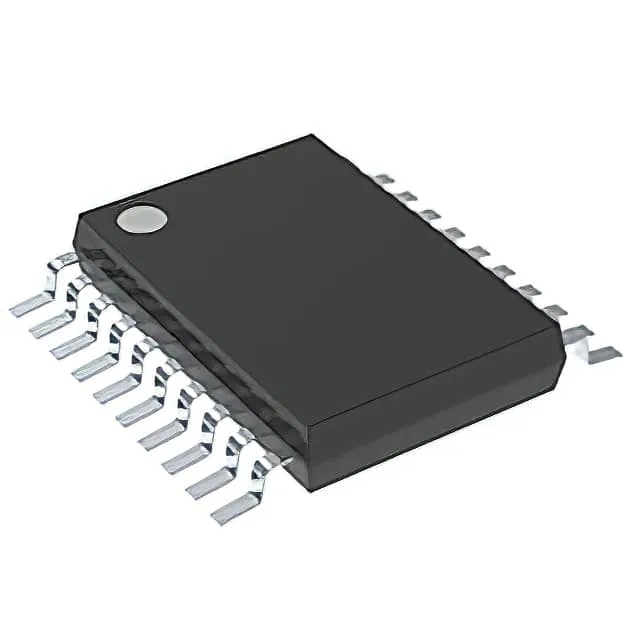
20-TSSOP — footprint and board integration
Housed in a 20-pin TSSOP with 0.65 mm pitch and 4.40 mm body width, the package is a surface-mount only form factor. The 0.173-inch (4.40 mm) width is standard for TSSOP-20, and the footprint matches the industry-common land pattern for this package family. No exposed thermal pad — all dissipation goes through the leads, so for continuous high-drive scenarios (all 8 outputs at 24 mA simultaneously), check the package thermal impedance against your ambient temperature and airflow.