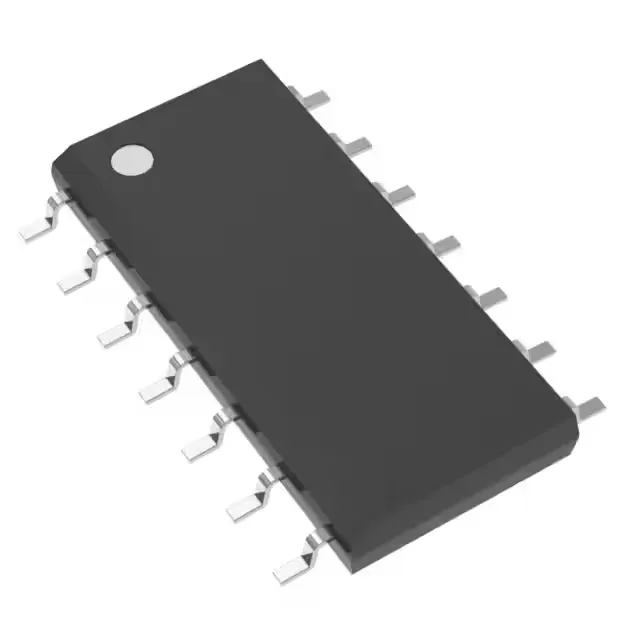
The 140 MHz clock rating and 8.8 ns max propagation delay at 5V, 50 pF load give this flip-flop enough speed to latch data on fast parallel or serial buses without violating setup/hold windows. In a typical automotive CAN transceiver interface or a high-speed counter input, that margin avoids metastability when the data edge arrives close to the clock edge. The 2 pF input capacitance keeps the clock-line load light, which simplifies drive budgeting on a shared bus.
That means it is tested and characterized for the thermal cycling, vibration, and voltage transients found in engine bays, transmission controllers, and chassis-mounted modules.
It is a current-production TI part with no announced last-time-buy or discontinuation. If you are freezing a BOM for a multi-year automotive program, this part does not carry the lifecycle risk that NRND or EOL parts do.
Package and mounting — 14-SOIC, surface-mount, tape-and-reel option
14-SOIC package (0.154" body width, 3.90 mm) is a common footprint.
8 mA output drive — direct interface to standard logic families
Each output sources or sinks 8 mA, which is enough to drive one or two standard 74AHCT or 74HCT loads, an LED indicator through a series resistor, or the input of a downstream microcontroller GPIO. The complementary outputs give both Q and /Q simultaneously, useful for differential signalling or generating inverted clocks without an extra inverter gate.