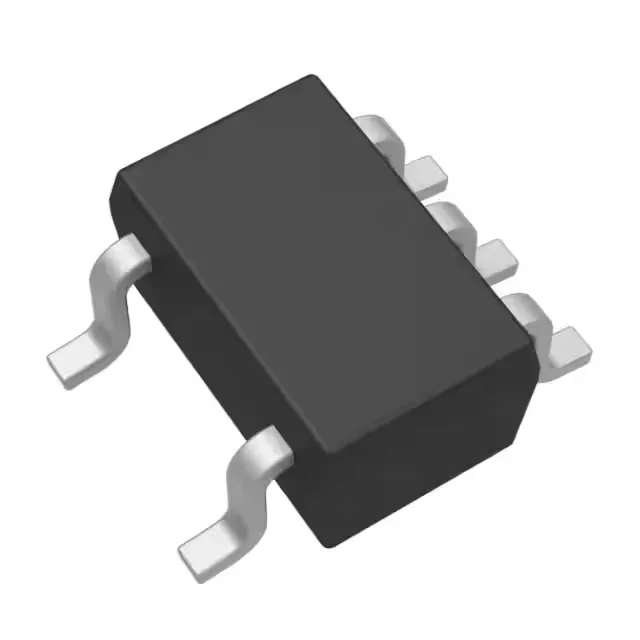
It takes a noisy or slow-rising input and outputs a clean, inverted logic level — the Schmitt-trigger hysteresis rejects chatter that a plain inverter would pass through. Supply range is 4.5 V to 5.5 V, making it a direct fit for 5 V TTL/CMOS systems. Propagation delay is 8 ns at 5 V with a 50 pF load, fast enough for most general-purpose logic interfaces and bus-buffering tasks. The SC-70-5 package (also known as SOT-353) saves board space — five pins, one input, one output, supply and ground. Quiescent current is 1 µA maximum, negligible in a mixed-signal power budget.
Schmitt-trigger input — cleans up the signal path
The Schmitt-trigger input gives this inverter a low-level threshold of 0.5 V to 0.6 V and a high-level threshold of 2 V. That hysteresis window means a slowly rising sensor output or a noisy clock line won't cause multiple transitions at the output. For a field-service tech troubleshooting a glitchy digital input, swapping in this part instead of a standard inverter often clears the problem without changing the upstream sensor.
8 mA output drive — drives a standard logic load
Output current is rated 8 mA source and 8 mA sink. That's enough to drive one or two standard TTL inputs, an LED indicator through a series resistor, or the clock input of a downstream flip-flop. It won't drive a relay coil directly — that's not what a single-gate inverter is for — but for logic-level fan-out it has margin.