What this 8-bit register does on your board
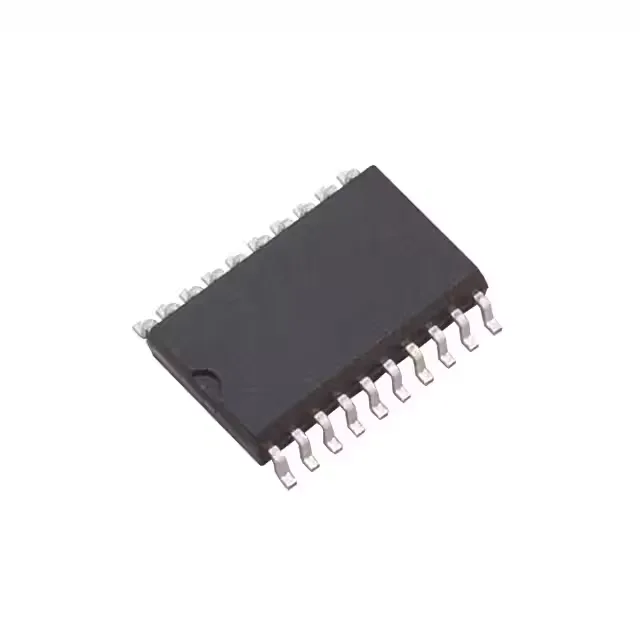
The Texas Instruments SN74ABT377ADW is an 8-bit D-type flip-flop with positive-edge triggering and non-inverted outputs, housed in a 20-pin SOIC wide-body (7.50 mm width) package. Each of the eight flip-flops captures the logic level at its D input on the rising edge of the clock and holds it until the next clock edge — standard register behaviour for buffering data, pipeline stages, or control-latch applications in 5 V digital systems. The 74ABT family is the advanced BiCMOS generation, offering higher speed and lower power than the original 74F or 74ALS series while staying TTL-compatible on the inputs and outputs.
Output drive — 32 mA source, 64 mA sink
The SN74ABT377ADW can source 32 mA and sink 64 mA per output — roughly double the drive of a standard 74F374 (24 mA). That matters when the register feeds a heavily loaded data bus, drives the base of a power transistor through a resistor, or directly lights an LED without a buffer. The 64 mA sink capability also helps terminate unterminated lines or pull down a bus in a wired-OR configuration. Keep the total package dissipation in mind: at 5 V, sinking 64 mA on all eight outputs simultaneously would exceed the 250 µA quiescent current by orders of magnitude, so the load duty cycle and thermal path through the SOIC-20 body need a quick check.