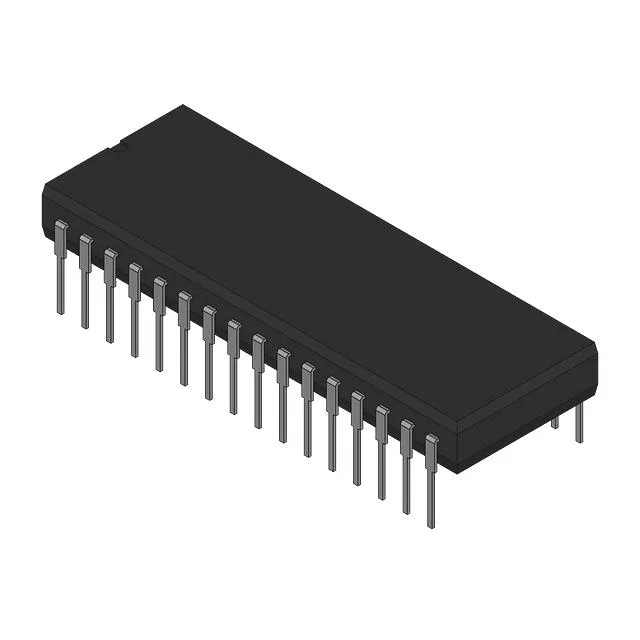
The NM27C040Q170 is a 4 Mbit parallel EPROM from ON Semiconductor, organized 512K x 8. The 170 ns access time is the headline timing spec: it tells you how fast the chip can present data after the address lines settle. For a legacy 8-bit microcontroller or a glue-logic memory map running at clock speeds up to roughly 10 MHz, this part fits without wait states. Push beyond that and you will need to stretch the bus cycle or look for a faster EPROM — but 170 ns is the sweet spot for most 8-bit and early 16-bit designs that originally used a 150–200 ns EPROM.
EPROM reality: UV erasure, separate programming voltage
This is an EPROM, not an EEPROM or Flash. That means erasing it requires a UV lamp (typically 253.7 nm at 12 Ws/cm² for 15–20 minutes), and programming needs a 12.5 V or 13 V Vpp supply — the 4.5 V Vcc listed is the read-only supply. No in-circuit reprogramming; you socket the part, erase it in a UV eraser, program it on a device programmer, and reinsert it. For production, you factory-program the EPROM and lock the firmware. For field updates, you swap the whole chip. The 32-CDIP through-hole package is socket-friendly — no hot-air station needed, just a chip puller and a fresh part from the kit.
That puts it in office equipment, test gear, telecom line cards in conditioned rooms, or any indoor chassis where the ambient stays above freezing and below 70°C. Not for under-hood, not for a rooftop enclosure in July. The 32-pin ceramic DIP (CDIP) is hermetic, so it handles humidity better than plastic DIP, but the temperature spec is the binding constraint.
Listed as Active. For a legacy product already using this EPROM, the active status gives you runway to keep sourcing it through standard distribution or independent channels.