FRAM-based 16-bit MCU for industrial sensing and metering
FRAM advantage over Flash MCUs
The MSP430FR6889IPN uses FRAM for program and data storage rather than conventional Flash. FRAM writes at bus speed without a page-erase cycle, so firmware updates and data logging incur no write-time penalty. Endurance is effectively unlimited for typical embedded use — 10^15 cycles versus the 10^4–10^5 cycles of Flash — which simplifies wear-leveling in the application layer. The trade-off is that FRAM density tops out lower than Flash at the same price point; 128 KB here suits mid-complexity control code and data logging, not large GUI or file-system payloads.
This removes the last-time-buy risk for new designs and production ramps. The base product number is MSP430FR6889; the IPN suffix indicates the 80-LQFP package and industrial temperature grade.
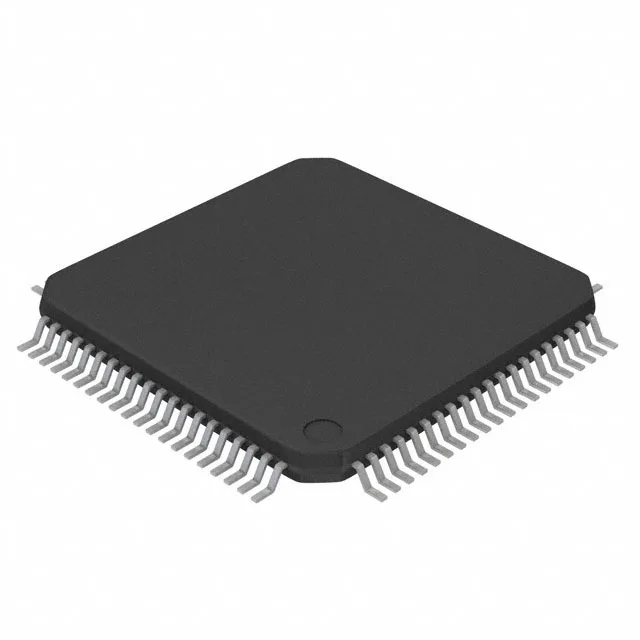
Housed in an 80-pin LQFP with a 12x12 mm body, the MSP430FR6889IPN is a surface-mount device suited for automated assembly. The internal oscillator reduces external component count, though the device also supports external crystal or resonator for precision timing.