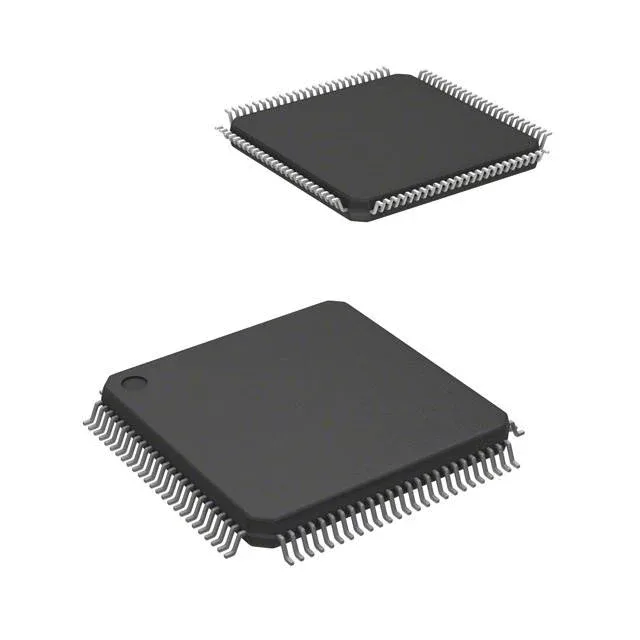
FRAM-based 16-bit MCU for low-power sensing and control
It belongs to the MSP430™ FRAM family, where program memory is 128 KB of ferroelectric RAM (FRAM) rather than Flash or EEPROM — meaning writes are fast, nearly unlimited in endurance, and non-volatile without a separate EEPROM bank. Typical applications include industrial sensor nodes, metering, portable medical devices, and battery-powered control systems where the combination of low active power and non-volatile memory simplifies the firmware update path.
128 KB FRAM — no wear-leveling, no separate EEPROM
The 128 KB FRAM program memory writes at bus speed and endures over 10¹⁵ read/write cycles — orders of magnitude more than Flash. That means you can log data or update firmware in the field without wearing out the memory array, and you don't need a separate serial EEPROM for calibration constants or configuration parameters. The 2K x 8 SRAM handles stack and scratchpad; for most sensor-logging and control loops, the FRAM serves as both code store and data logger.
16 MHz CPUXV2 — enough for sensor fusion and Modbus loops
The 16 MHz CPUXV2 is a 16-bit RISC core with a hardware multiplier. It handles typical control loops — PID, sensor compensation, Modbus RTU frames — without breaking a sweat. For applications that need higher throughput, the MSP430FR family includes faster parts, but at 16 MHz this device stays in the low-power sweet spot: active current is typically under 100 µA/MHz, and the FRAM eliminates the Flash-wait-state penalty at this clock speed.
83 I/O and 16-channel ADC in a 100-LQFP
The 100-LQFP package brings out 83 general-purpose I/O pins — enough to drive a segment LCD, read a keypad matrix, and talk to several serial peripherals simultaneously. The 16-channel 12-bit ADC samples at up to 200 ksps and can be triggered by the timer or DMA without CPU intervention.