What this MSP430 FRAM MCU brings to a BOM
Its headline feature is 96 KB of FRAM program memory — a non-volatile storage that writes at near-SRAM speeds with effectively unlimited endurance, unlike Flash.
This means TI has stopped manufacturing it, and no further last-time-buy windows are open through the franchised channel. Any stock that exists today is already in the independent distribution pipeline — broker-held inventory, factory overruns, or material pulled from end-of-life buy lots. Sourcing through independent distribution is the only path, and every reel pulled from that channel reduces the pool. A cross-reference search against the MSP430FR6888 base product number will surface active siblings with matching or upgraded FRAM size and peripheral sets — but each requires firmware re-targeting and re-validation. There is no drop-in direct replacement from TI for this exact obsolete code.
16 MHz and FRAM — the performance envelope
At 16 MHz, this is not a number-crunching core — it is a control-loop and data-acquisition MCU sized for moderate throughput with ultra-low power as the priority. The CPUXV2 pipeline executes most instructions in a single cycle at that clock, so the 16 MHz ceiling translates to roughly 16 MIPS. The real differentiator is the 96 KB FRAM: it replaces both Flash and EEPROM in a single unified memory space. No erase cycles, no write-page buffers, no sector boundaries to manage in software. A data logger can write a byte at a time to the same address a million times without any wear-leveling scheme. That is the spec that justifies choosing this part over a comparably-priced Flash MCU.
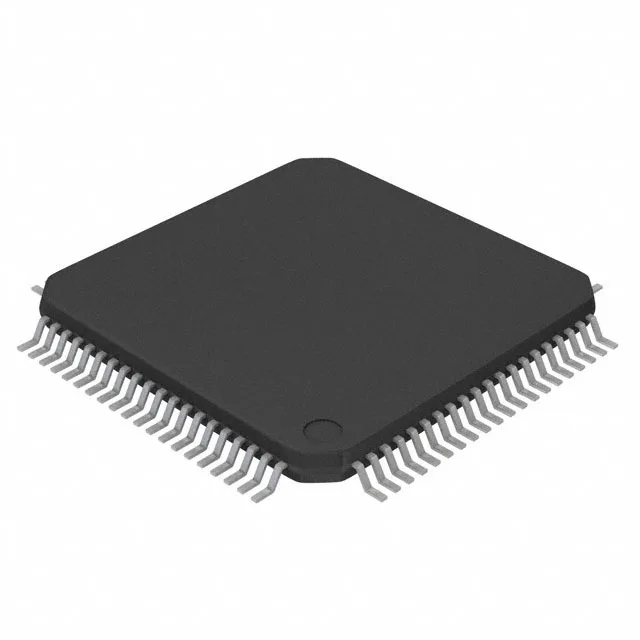
The MSP430FR6888IPNR ships in an 80-pin LQFP with a 12x12 mm body and 0.5 mm pitch.