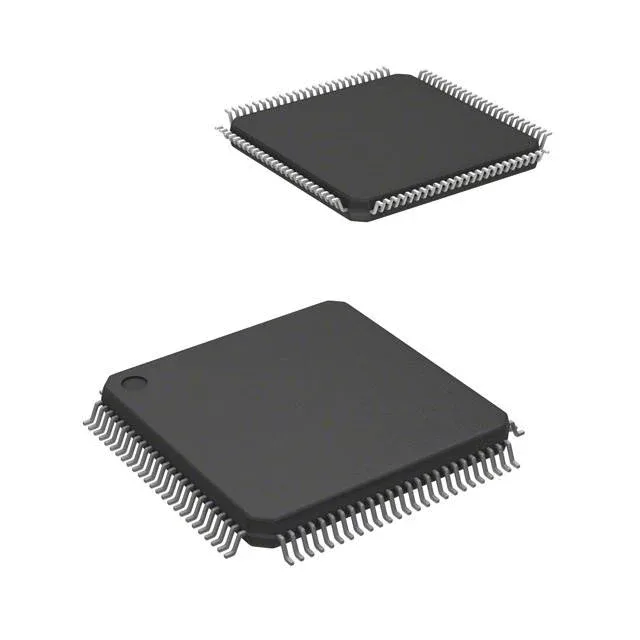
FRAM microcontroller — what you get with the MSP430FR6887IPZR
That means no erase cycles before writes, no wear-leveling in firmware, and lower active power during memory operations. The 2K x 8 RAM handles stack and scratchpad data. With 83 I/O lines, a 12-bit ADC sampling 16 channels, and connectivity for I²C, SPI, UART, and IrDA, this part targets sensor-fusion nodes, metering, and portable instrumentation where low power and unified non-volatile storage matter more than raw throughput.
For a production BOM that already qualifies this part, the options are a last-time-buy through surplus inventory or a pin-compatible migration to a current MSP430 FRAM device. Buyers should expect to work with a broker or independent distributor who can locate remaining inventory or recommend a validated alternate.
16 MHz CPU and FRAM — the so-what for firmware
The 16 MHz clock is the CPUXV2 core's maximum rated speed. At this frequency, instruction throughput is roughly 16 MIPS for single-cycle operations. The FRAM access time is fast enough that zero-wait-state execution is typical up to 8 MHz; at 16 MHz the memory controller inserts one wait state per access, which the datasheet's timing tables cover. For a battery-powered sensor node waking briefly to log a reading and going back to sleep, the 16 MHz ceiling is generous — the part can run at lower clock speeds to save dynamic power. FRAM's write endurance is effectively unlimited compared to Flash — rated for 10^15 write cycles — so the firmware can update configuration tables or calibration constants in-place without wear-leveling logic. The 64 KB program space is enough for a modest RTOS, a communication stack, and application code for a single-function instrument. If the firmware needs more than 64 KB, a migration to a higher-density MSP430 FRAM part (128 KB or 256 KB) is the natural step, though the package and pinout may differ.
100-LQFP package — board-level considerations
The MSP430FR6887IPZR comes in a 100-pin LQFP with a 14x14 mm body and 0.5 mm pitch. That is a fine-pitch QFP requiring a reflow profile with careful paste deposition and alignment — standard for most assembly houses. The supplier device package code is 100-LQFP (14x14).